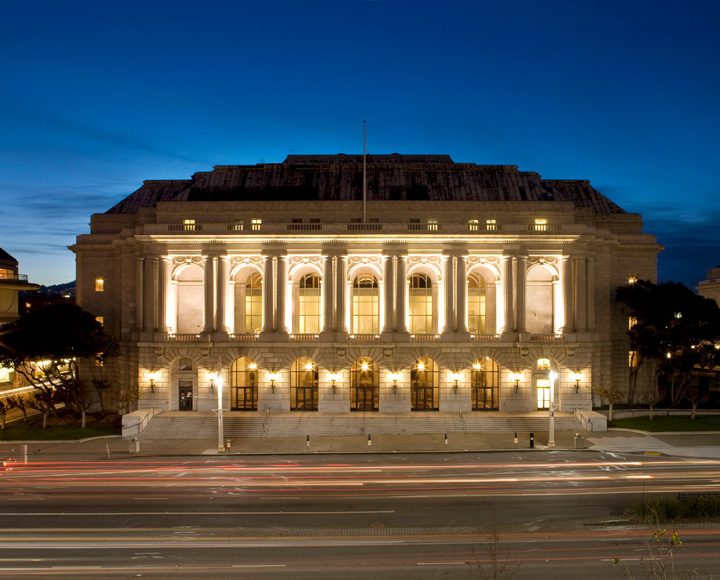

Few cities wear their contradictions as gracefully as San Francisco – a place where old-world sophistication meets restless innovation, and where the fog that drifts over the hills seems to carry whispers of both history and reinvention. At the heart of this dynamic city stands one of its most majestic landmarks: the War Memorial Opera House, a building that embodies both artistic grandeur and civic remembrance.
A Vision of Harmony: Birth of a Cultural Landmark
The War Memorial Opera House opened its doors on October 15, 1932, in the midst the Great Depression, an era when few cities dared to dream on such a scale. Yet San Francisco’s leaders and citizens believed that beauty and culture could be powerful acts of resilience. The project emerged as part of a broader vision known as the San Francisco War Memorial Complex, conceived to honor the soldiers who had fought in World War I while creating a civic center for art, democracy, and peace. Architect Arthur Brown Jr., already famous for designing San Francisco City Hall, who chosen to bring this vision to life. His creation would become one of the finest examples of Beaux-Arts architecture in the United States, a style that balanced neoclassical order with restrained opulence, perfectly suited to a city that saw itself as both European in taste and American in spirit.
The Architecture: Grandeur in Restraint
Approaching the War Memorial Opera House along Van Ness Avenue, one is greeted by a building that excludes classical dignity. Its colonnaded façade, adorned with monumental Corinthian columns, recalls the civic temples of ancient Rome, while its symmetrical design mirrors the ideals of harmony and proportion central to the Beaux-Arts tradition. Constructed primarily from California granite and limestone, the exterior reflects light in subtle shades that change with the day; soft silver in the morning fog, warm gold at sunset. Above the main entrance, sculptural reliefs by Ossip Zadkine pay homage to music, art and the human spirit’s triumph over war. Inside, the tone shifts from civic solemnity to pure theatrical splendor. The grand lobby, with its soaring barrel-vaulted ceiling and marble floors, leads visitors into the heart of the building, a 3,126-seat auditorium designed with both grandeur and intimacy in mind. The walls and balconies are lined with pale ivory and gold leaf, and the ceiling glows with a magnificent crystal chandelier, suspended beneath a dome painted with allegories of music and drama. The acoustics, engineered with extraordinary precision, lend the space a clarity that has long made it one of America’s finest houses for opera and symphonic performance.
A Theater of History and Hope
From its earliest days, the War Memorial Opera House was more than a venue; it was a civic statement. The building’s very name reflects its dual purpose: to honor the memory of the fallen while celebrating the creative forces that define humanity. During World War II, the opera house became a gathering place for both artists and patriots. But its most historic moment came after the war, in 1945, when it hosted the United Nations Conference on International Organization – the meeting that gave birth to the United Nations Charter. It is a poetic truth that this temple of music also become a temple of peace. In the same hall where Verdi and Puccini’s arias once soared, world leaders signed the founding document of e new global order – a rare moment when art, diplomacy and idealism shared the same stage.
A Stage for Greatness
Since its opening, the War Memorial Opera House has been home to two of the city’s most prestigious cultural institutions: the San Francisco Opera and the San Francisco Ballet. Both have shaped the city’s identity as a world capital of performing arts. The opera house’s stage has hosted some of the most celebrated voices of the 20th and 21st centuries: Leontyne Price, Luciano Pavarotti, Renée Fleming, Plácido Domingo, and Anna Netrebko among them. The San Francisco Ballet, founded in 1933, is the oldest professional ballet company in the United States and continues to premiere groundbreaking contemporary works alongside the classics. In 1989, the building sustained damage during the Loma Prieta earthquake, but it was swiftly restored with a deep respect for its architectural heritage. The major renovation, completed in 1997, improved seismic stability, stage technology, and audience comfort while preserving every detail of its historic elegance.
Design in Detail: A Living Classic
The War Memorial Opera House stands as a textbook example of Beaux-Arts urban design. Its placement within the Civic Center complex was intentional: directly facing City Hall across a broad plaza, it forms a dialogue between government and culture, between civic duty and creative expression. The interiors reflect a balance between French-inspired luxury and American practicality. The use of white marble, bronze fixtures and oak paneling creates an atmosphere that is opulent without ostentation. Even the staircases, with their elegant balustrades and subtle curvature, seem designed to make every visitor feel part of a grand procession. Modern lighting and stage technologies have been seamlessly integrated into the building’s classical shell, ensuring that 21st-century performances can unfold within a timeless architectural frame.
A Civic and Cultural Icon
Beyond its artistic role, the War Memorial Opera House remains a cornerstone of San Francisco’s identity. It is a place where the city gathers to celebrate – from opening nights and gala events to public ceremonies and cultural festivals. It is also a place of quiet reflection. The words „War Memorial” inscribed above its entrance serve as a reminder that beauty often arises from loss, and that art can be a bridge between memory and renewal.
The Evolution Continues
Yet perhaps what makes the War Memorial Opera House most remarkable today is its continued ability to reinvent itself without abandoning its roots. In recent years, its stage has embraced not only opera and ballet, but also interdisciplinary collaborations, film-in-concert, contemporary dance residencies, and commissions from new composers eager to write the next chapter of the art form. The building has become a bridge between tradition and experiment — a place where new generations discover the magic of live performance for the first time, and where seasoned patrons return to be reminded that beauty is not static, but alive, evolving, and capable of speaking to every era with a fresh voice.