Luisa Miller at Palau de Les Arts

IMG_7436

Author:

by Blanca Vázquez

INTRODUCTION

BIOGRAPHY

Read more

INTERVIEW

On August 13, 1849, Giuseppe Verdi received the libretto of the opera initially titled Eloisa Miller from his librettist Salvadore Cammarano, a frequent collaborator of the composer on works such as Alzira, La battaglia di Legnano, Luisa Miller, and Il trovatore. Cammarano had left unfinished a previous project inspired by Shakespeare’s King Lear, highlighting Verdi’s ambition to explore profound human conflicts. It is striking that Luisa Miller, one of Verdi’s most refined works in terms of dramatic construction, emerged as a result of the cancellation of a contract with Naples’ Teatro San Carlo; Verdi was compelled—not only by institutional pressure but also by threats against his librettist—to undertake this creation.

The composer’s initial idea had been to adapt Francesco Domenico Guerrazzi’s novel L’assedio di Firenze, but Cammarano recommended moving away from revolutionary themes and revisiting an earlier proposal by Verdi: an adaptation of Schiller’s Kabale und Liebe. The influence of the Sturm und Drang movement, which informs Schiller’s work, imbues Luisa Miller with intense romantic drama, in contrast to the Neoclassical rationalism that preceded it. Three concepts—truth, freedom, and emotion—serve as the pillars of the work, structuring a drama in which amorous intrigues heighten tension without detracting from the central focus: an impossible love that mirrors a painful social truth.

Luisa Miller marks the beginning of a second creative period in Verdi’s career, in which heroic epics and revolutionary exaltation give way to a more intimate and psychological examination of character. The opera anticipates Rigoletto(1851), the first installment of Verdi’s mature trilogy along with Il trovatore (1853) and La traviata (1853), consolidating the path toward the dramatic richness that defines his central period.

The revival of Luisa Miller at Les Arts in 2008 confirmed the work’s enduring relevance and Verdi’s vision of featuring two prima donna roles. Mariangela Sicilia, in the role of Luisa, delivered an outstanding performance, combining timbral brilliance, precise diction, and expressive depth to master the demanding vocal range of the role. Maria Barakova, as Federica, exhibited a homogeneous voice and impeccable musical interpretation, while Lora Grigorieva, from the Centre de Perfeccionament, brought a beautiful vocal color and notably expressive portrayal to the role of Laura.

Alex Esposito created a Walter of commanding stage authority, projecting a cold, controlling charisma, supported by vocal and technical mastery that highlighted the complexity of the character. In contrast, Gianluca Buratto, as Wurm, provided the perfect foil, while Germán Enrique Alcántara, portraying Miller, stood out for his expressivity and interpretive solidity.

The most anticipated debut of the evening was undoubtedly that of tenor Freddie De Tommaso as Rodolfo. Known primarily for his Puccinian repertoire, De Tommaso demonstrated in Quando le sere al placido the quality of his instrument, solid technique, and innate expressivity, foreshadowing a promising career even in the most demanding roles at top opera houses.

In the conductor’s role, Sir Mark Elder delivered a reading of remarkable coherence and sensitivity, balancing the voices with the orchestra and enhancing the dramatic cohesion of the production. The Orquesta del Palau de Les Arts and the Coro de la Generalitat, under Jordi Blanch, produced a rounded, flexible, and blended sound, providing a solid foundation for the musical drama.

Valentina Carrasco’s stage direction deserves special mention: together with her technical team—Carles Berga (scenography), Luciana Gutman (costume), and Antonio Castro (lighting)—she transformed the 19th-century doll factory into a theatrical space of striking conceptual coherence. The use of two parallel stages not only respected the narrative of the libretto but also effectively emphasized the social divisions between the characters.
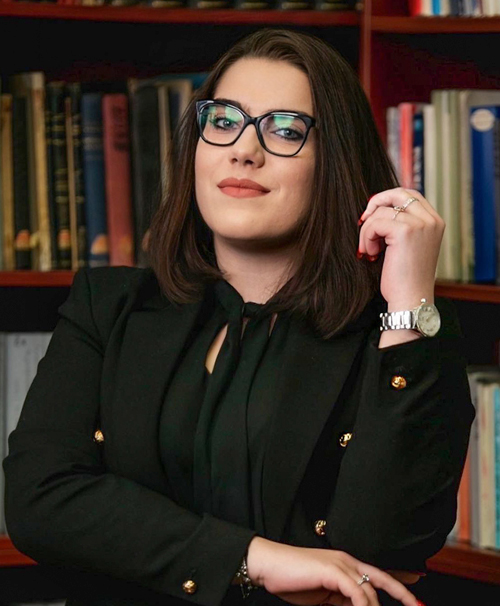
Alice Lechner

Alice Lechner comes from a music-loving family. Her first encounter with the opera universe was at the tender age of six. The grandeur of the stage productions and costumes, the backstage chatter, and last, but definitely not least, the music left her in awe, beginning with Mozart’s Don Giovanni. The overall feeling that opera awakens in anyone who gets a glimpse into this part of artistic eternity, that each and every day passes the test of time, was what drew her to stay and be a part of this world. The Opera House of Brașov became her second home, and the people who worked there were her second family.

Since then, Alice has devoted her spare time to maximising her musical knowledge through instrumental studies, studying both piano and violin for a short time. In the following years, her number one passion stepped out of the limelight and graciously gave way to Law Studies.
Since 2018 she has been studying Law at “Alexandru Ioan Cuza” University in Iași.

Her passion for opera, even if it is no longer her top professional priority in terms of career, it has most definitely become her priority during her free time. Wanting to experience the best of both worlds and extend her musical horizons, she regularly attends opera performances throughout Romania and abroad.
With OPERA Charm Magazine, Alice aims to nurture her creative side to help it flourish and bloom and to discover, alongside the magazine’s readers, the fascinatingly complex world of opera.

Currently, she is an LL.M. in Business Law at “Alexandru Ioan Cuza” University in Iași.

Oana Zamfir

Oana Zamfir is a second year MA student at the “George Enescu” National University of Arts, at the Department of Musicology.

She studied violin for 12 years at the “Stefan Luchian” High School of Art in Botosani, later focusing on the theoretical aspects of music. In 2019 she completed her bachelor studies in Musicology as a student of the National Academy of Music “Gheorghe Dima” in Cluj-Napoca. Her research during 2018-2019 brought to the forefront elements of the archaic ritual within works of composers who activated during the communist period, giving her the opportunity to start a research internship at the “Carl von Ossietzky” University in Germany. In this context, she recorded conversations with members of the Sophie Drinker Institute in Bremen, and had access to documents directly from the Myriam Marbé archive.

Since 2019 she has been a teacher of Music Education and Theoretical Music Studies, making full use of interactive methods in the musical training of students and working, at the same time, with the children’s choir founded in the first year of her activity.

Her interests include pursuing a degree in interior design in 2020.

Alexandru Suciu

Alexandru Suciu inherited his passion for art growing up in a family of several generations of musicians. He began his musical studies at the “Augustin Bena” School of Music in Cluj, where he studied piano and guitar. Even though his main study direction was philological, his passion for music prevailed. He began his academical journey at the Faculty of Letters of the “Babeș-Bolyai” University, studying Comparative literature and English. He continued by studying Opera Singing at the “Gheorghe Dima” National Music Academy. He also graduated the Musical Education section, followed by Artistic Directing at the Musical Performing Arts department.

His multidisciplinary education opened the doors towards research, which is seen both through his participation in national and international conferences and symposia, such as the Salzburg Easter School PhD-forum, organized by the Salzburg Universität or the Silesian Meeting of Young Scholars, organized by the Institute of English at the University of Silesia, as well as the collaboration with Opera Charm Magazine.

During his student years, he won several prizes, including the Grand Prize at the “Paul Constantinescu” National Musical Interpretation Competition, the Romanian Composers and Musicologists’ Union Prize at the same competition, the First Prize and the Schubert Prize at the “Ada Ulubeanu” Competition.

He further developed his artistic skills by specializing in courses and masterclasses held by personalities such as Vittorio Terranova, Giuseppe Sabbatini, Marian Pop, Ines Salazar, Riccardo Zanellato, Paolo Bosisio, Valentina Farcaș and Manuel Lange in contexts such as the Internationale Sommerakademie für Operngesang Deutschlandsberg, Corso Internazionale di Canto Lirico I.M.C. Licata or the Europäische Akademie für Musik und darstellende Kunst Montepulciano. Besides his activity on-stage, he currently teaches Opera Singing Didactics, and Pedagogical Practice within the Department for Teacher Education and Training at the “Gheorghe Dima” National Music Academy.

Cristina Fieraru

Cristina is a 24 year-old Romanian soprano & a student at the National University of Music Bucharest, where she pursues the MA program in Vocal Performance.

She made her debut in Pamina from “Die Zauberflöte” by Wolfgang Amadeus Mozart at only 19 years old at the Bucharest National Opera House, as a member of the Ludovic Spiess Experimental Opera Studio. Over the years she made her debut in roles such as Contessa d’Almaviva (Le nozze di Figaro), Mimì & Musetta (La Bohème), Alice Ford (Falstaff), Erste Dame (Die Zauberflöte) in her university’s opera productions.
Her passion and experience extends in the field of choral music, too.

She has been part of our dream team since the fall of 2021. For a good period of time she took care of OPERA Charm’s social media and took you on the monthly journey through the history of opera through our Legends rubric – and a few times through the Theaters around the World rubric.

Her little soul rubric – from 2021 to present – is definitely the Conductors of the Future, where, every month, she gives you the chance to meet a young star of the world of conducting and, of course, to find out what’s the most charming feature of opera in these artists’ views.

BIANCA L. NICA

Lorem ipsum dolor sit amet, consetetur sadipscing elitr, sed diam nonumy eirmod tempor invidunt ut labore et dolore magna aliquyam erat, sed diam voluptua. At vero eos et accusam et justo duo dolores et ea rebum. Stet clita kasd gubergren, no sea takimata sanctus est Lorem ipsum dolor sit amet. Lorem ipsum dolor sit amet, consetetur