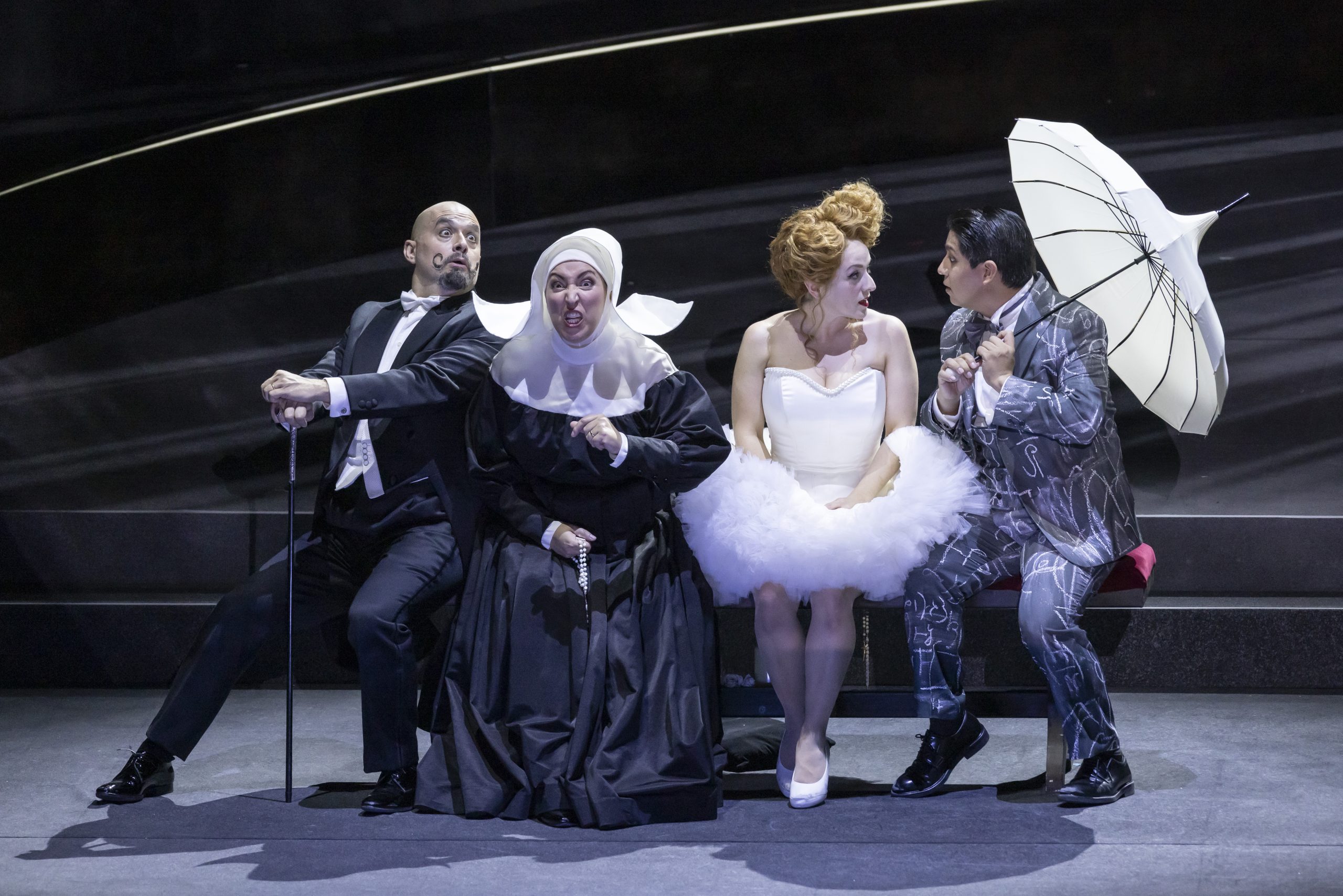
On October 15, the final performance of Charles Gounod’s Faust was staged in Valencia. With this production, the Palau de les Arts opens the season celebrating the 20th anniversary of its inauguration.
Charles Gounod, originally a composer of sacred music, had little success with his first operas. In 1856, he persuaded the playwright Jules Barbier and his collaborator Michel Carré to write the libretto for what would become one of the most celebrated works of his career. Léon Carvalho, director of the Théâtre Lyrique in Paris, agreed to stage the opera. The work was already halfway completed when the Théâtre Porte-Saint-Martin presented a large-scale production of the melodrama Faust. Carvalho then withdrew his agreement to stage Gounod’s opera and offered him a replacement project based on Molière’s Le Médecin malgré lui. Following the considerable success of that opera (premiered on January 15, 1858) and the poor reception of the Porte-Saint-Martin Faust, Gounod decided to complete his own Faust. The score was finished on July 1, 1858, and premiered on March 19, 1859, at the Théâtre Lyrique in Paris.
The evening of October 15, 2025, began with a message from the current general director, Jorge Culla, regarding the general strike called in Spain that day, which particularly affected the staging aspects, preventing the opera from being enjoyed in its full splendor. Even so, it was still possible to appreciate the outstanding work of stage director Johannes Erath and the technical team accompanying him in this circus-inspired production: set designer Heike Scheele, lighting designer Fabio Antoni, costume designer Gesine Völlm, and video designer Bibi Abel, who was probably the most affected, since the planned projections could not be shown.
The protagonist, performed on this occasion by the young tenor Iván Ayón-Rivas, offered a bold interpretation of Faust—not only due to the complexity of the character, but also because of the vocal difficulty of the role and its eminently lyrical line. The tenor’s magnificent vocal projection was also evident, suggesting a promising future in the lyrical repertoire. The Spanish soprano Ruth Iniesta, one of the most renowned singers on the national scene, took on a more lyrical role than usual this time. In her portrayal of Marguerite, she stood out for her technical mastery and musicality, especially in the climaxes and the delicacy of her pianissimos.
In the role of Méphistophélès, Alex Esposito did not leave the audience indifferent. With a mature voice, rich in harmonics and great power, he embodied the part with authority and intensity. Warm recognition is also due to Florian Sempey, who played Valentin with great expressiveness.
Conductor Lorenzo Viotti, making his debut at the Valencian venue, offered the audience a highly contrasted and intense interpretation, drawing from the Orquestra de la Comunitat Valenciana and the Cor de la Generalitat Valenciana an exquisite result.
Ekaterine Buachidze, as Siébel, was very convincing in her role and stood out for the velvety color of her voice. Gemma Coma-Alabert delivered an excellent vocal and dramatic performance as Dame Marthe. Special mention should also go to Bryan Sala, in the role of Wagner and a member of the Centre de Perfeccionament de Les Arts, who displayed great interpretative skill.