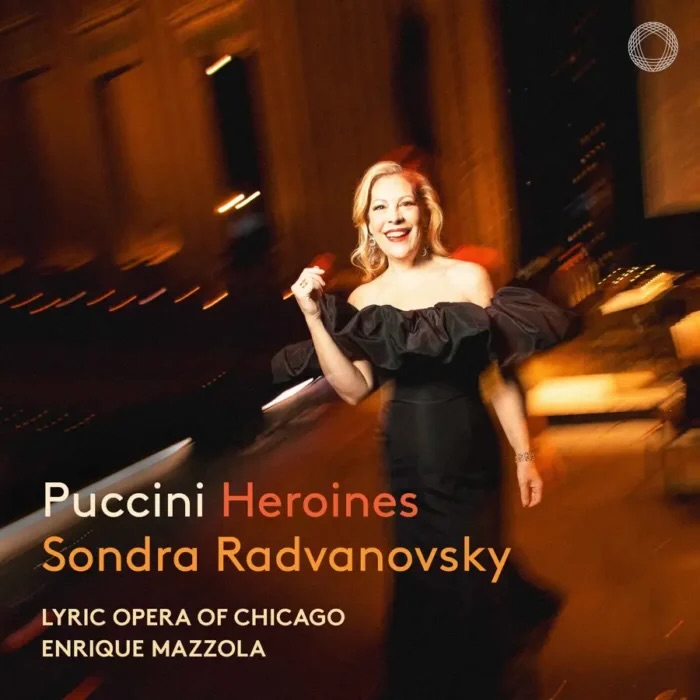
Soprano Sondra Radvanovsky has long been celebrated for her dramatic intensity and vocal prowess, but in her latest recording,Puccini Heroines, she takes us on a journey through the heart of Puccini’s operatic world with an intimacy and depth that few can match. This album is not merely a showcase of technique; it is a testament to Radvanovsky’s ability to embody character and bring the emotional landscape of Puccini’s women to vivid life.
From the opening notes, it is evident that Radvanovsky approaches each aria with both respect for the composer’s genius and her own interpretive insight. Her Mimi (La Bohème) is tender, vulnerable, and achingly human. There is a delicate fragility in her voice that captures Mimi’s innocence and longing, yet Radvanovsky never sacrifices tonal richness or clarity. Each line she sings seems to tell a story, whether it’s a whisper of hope or a lamentation of loss, drawing the listener into Mimi’s world with profound intimacy.
Contrast this with her portrayal of Turandot, in which Radvanovsky commands the stage with an almost imperious authority. Here, she balances icy regal power with subtle hints of emotion, revealing the inner complexity of Puccini’s famously formidable princess. Her articulation is precise, her dramatic instincts impeccable, and her voice cuts through the orchestration with thrilling clarity. One cannot help but be captivated by the tension she creates between the character’s fearsome exterior and her hidden vulnerability.
Radvanovsky’s Manon LescautandTosca are similarly compelling. She navigates Manon’s youthful exuberance and tragic fate with a keen sense of dramatic timing, infusing each phrase with emotional truth. InTosca, she channels the character’s fierce determination and passionate love with a voice that is both commanding and sensually expressive. It is in these moments that Radvanovsky’s artistry transcends mere technique; she becomes the character, offering a fully realized dramatic experience that lingers long after the final note.
The orchestral accompaniment throughout the album is sensitive and responsive, providing a lush backdrop that enhances Radvanovsky’s performance without ever overwhelming it. The subtle interplay between voice and orchestra in the slower, more lyrical arias allows for moments of quiet introspection, while the dramatic climaxes are rendered with thrilling intensity, highlighting the full range of both Puccini’s compositions and Radvanovsky’s vocal capabilities.
What makes this recording particularly remarkable is Radvanovsky’s ability to maintain both power and nuance simultaneously. She navigates the demanding tessitura of Puccini’s heroines with technical mastery, yet never allows vocal fireworks to overshadow emotional authenticity. Every crescendo, every pianissimo, every carefully shaped phrase serves the drama and brings the characters’ inner lives into sharp relief.
Puccini Heroines is ultimately a celebration of both the composer’s genius and the interpretive skill of one of opera’s leading sopranos. It offers listeners an opportunity to experience Puccini’s iconic female characters through the lens of an artist who understands not only the technical demands of the repertoire but also the profound emotional resonance that makes these roles timeless. Radvanovsky’s performance is a masterclass in operatic storytelling: bold, heartfelt, and unforgettable. It is Mazzola’s conducting that frames these performances, shaping the orchestral sound in ways that allow the soprano’s voice to soar without ever losing the richness of Puccini’s score. His approach is attentive, responsive, and dramatically intelligent: he seems to intuitively understand when to push the orchestra forward and when to pull back, creating an environment in which Radvanovsky can inhabit her characters fully.
Mazzola brings a rare combination of precision and emotional insight to the music. In the lyrical passages of Manon Lescaut, for example, he supports Radvanovsky’s expressive phrasing with a delicate orchestral palette, emphasizing subtle shifts in mood and tension. In the dramatic climaxes of Tosca or Turandot, he allows the orchestra to swell with grandeur while maintaining clarity and focus, ensuring that Radvanovsky’s voice never gets lost in the intensity. The result is a seamless partnership between singer and conductor, where the music breathes naturally and every emotional nuance is conveyed with impact.
For anyone seeking a recording that combines vocal brilliance with dramatic insight, Puccini Heroines is an essential addition to the collection. It is a vivid reminder of why Sondra Radvanovsky continues to captivate audiences worldwide and why Puccini’s women remain some of the most compelling figures in the operatic canon. This is not just an album—it is an intimate, thrilling journey through the passions, heartbreaks, and triumphs of some of opera’s most extraordinary heroine.