
Italiano: Quando Rossini presentò Le Siège de Corinthe a Parigi nel 1826, l’opera non era del tutto nuova. Alla sua origine si trovava Maometto II, opera che il compositore aveva presentato per la prima volta a Napoli nel 1820. Tuttavia, più che considerare Le Siège de Corinthe come una semplice reutilizzazione di una partitura precedente, è più corretto intenderla come una trasformazione di quell’opera, adattata a un pubblico, a una lingua e a una tradizione operistica differenti.
In Maometto II, Rossini aveva portato in scena la conquista ottomana di Negroponte, nell’attuale Eubea, nel 1470. Per Parigi decise di modificare sia l’ambientazione storica sia alcuni elementi drammatici. L’azione venne trasferita a Corinto, durante la conquista ottomana del 1458, e il risultato fu un’opera in francese concepita specificamente per il grande spettacolo del Théâtre de l’Académie Royale de Musique, oggi conosciuto come Opéra National de Paris.
È importante considerare anche le circostanze dell’arrivo di Rossini in Francia. Quando si trasferì a Parigi nel 1824, il compositore si trovò immerso in un ambiente operistico molto diverso da quello italiano nel quale aveva costruito la propria fama. Il teatro parigino cercava di mantenere il fascino delle grandi produzioni storiche e spettacolari che avevano caratterizzato i primi decenni del secolo, ma allo stesso tempo era alla ricerca di nuove forme espressive.
In questo contesto, la figura di Gaspare Spontini, considerato uno dei compositori più strettamente legati all’Impero napoleonico e, insieme a Meyerbeer, una delle figure che contribuirono allo sviluppo del nuovo genere della grand opéra, aveva lasciato un’impronta particolarmente importante. Le sue opere avevano definito un modello teatrale di grandi dimensioni, fondato su ampie masse corali, situazioni solenni e scenografie monumentali.
La collaborazione con il drammaturgo Alexandre Soumet fu fondamentale per trasformare Maometto II in un’opera adatta al palcoscenico parigino. Rossini non si limitò a tradurre la sua opera italiana: riorganizzò e modificò il materiale musicale, introdusse nuovi elementi e rafforzò quegli aspetti che il pubblico francese si aspettava da una grand opéra. Il balletto, i cori, le grandi scene d’insieme e la spettacolarità visiva divennero componenti fondamentali dell’opera.
Rossini riuscì così a mettere in dialogo due tradizioni. Da una parte, mantenne elementi legati alla sua esperienza nell’opera italiana: l’importanza della linea vocale, il virtuosismo e una scrittura particolarmente impegnativa per i cantanti. Dall’altra, accolse le dimensioni e le convenzioni del grande spettacolo francese. Il risultato non è quindi semplicemente una versione francese di Maometto II, ma un’opera che acquisisce una propria identità.
Il Cast
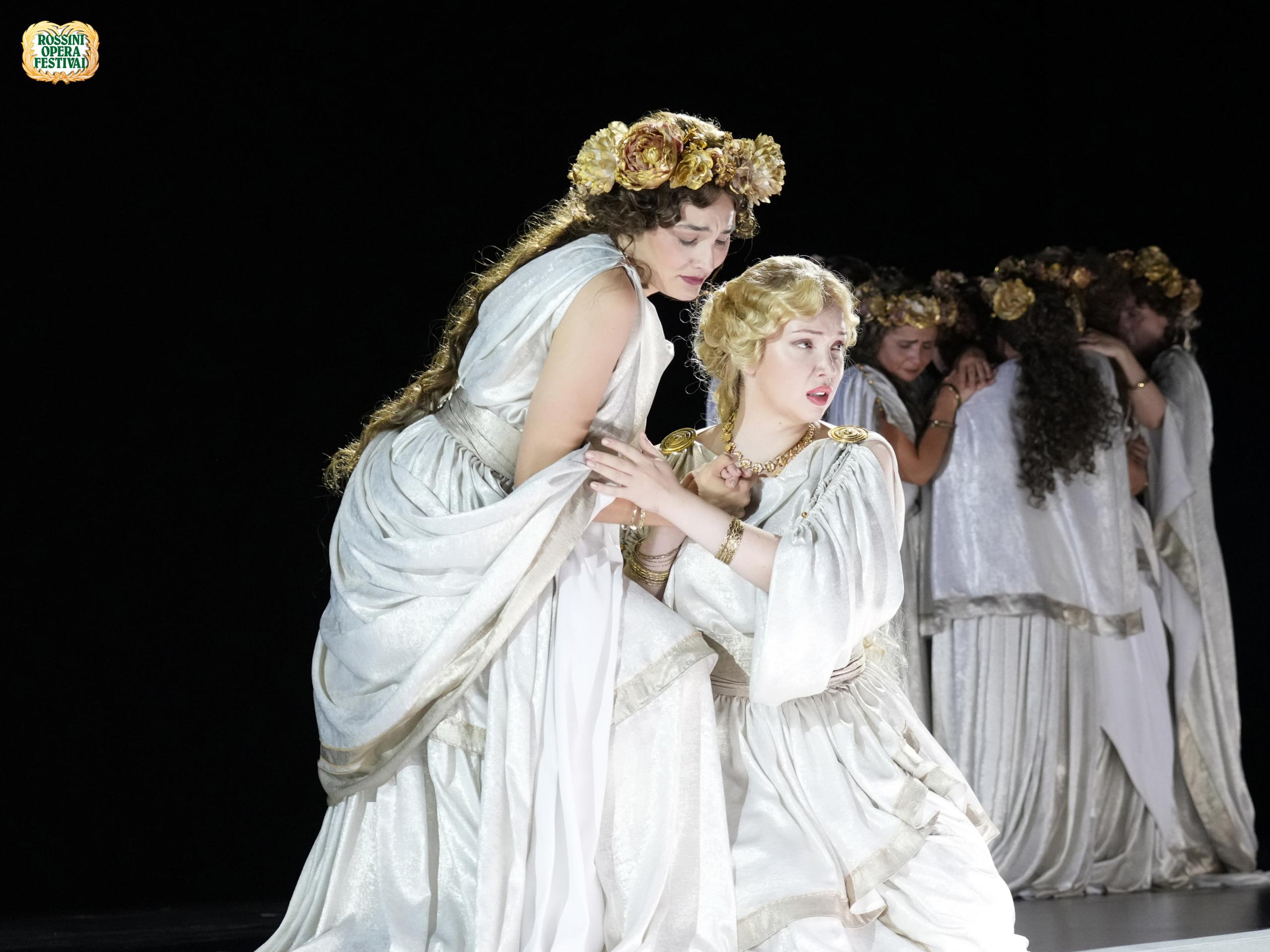
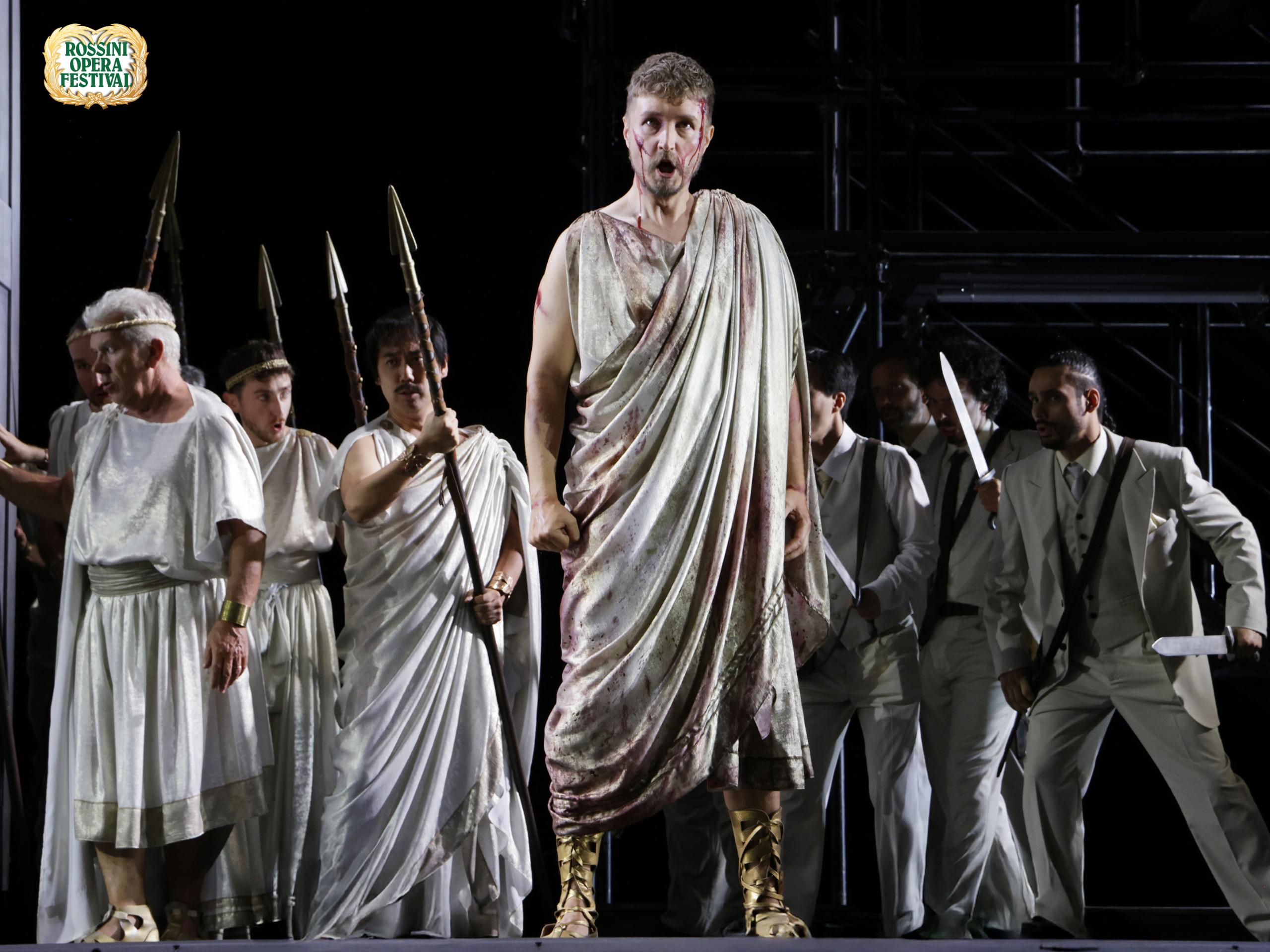
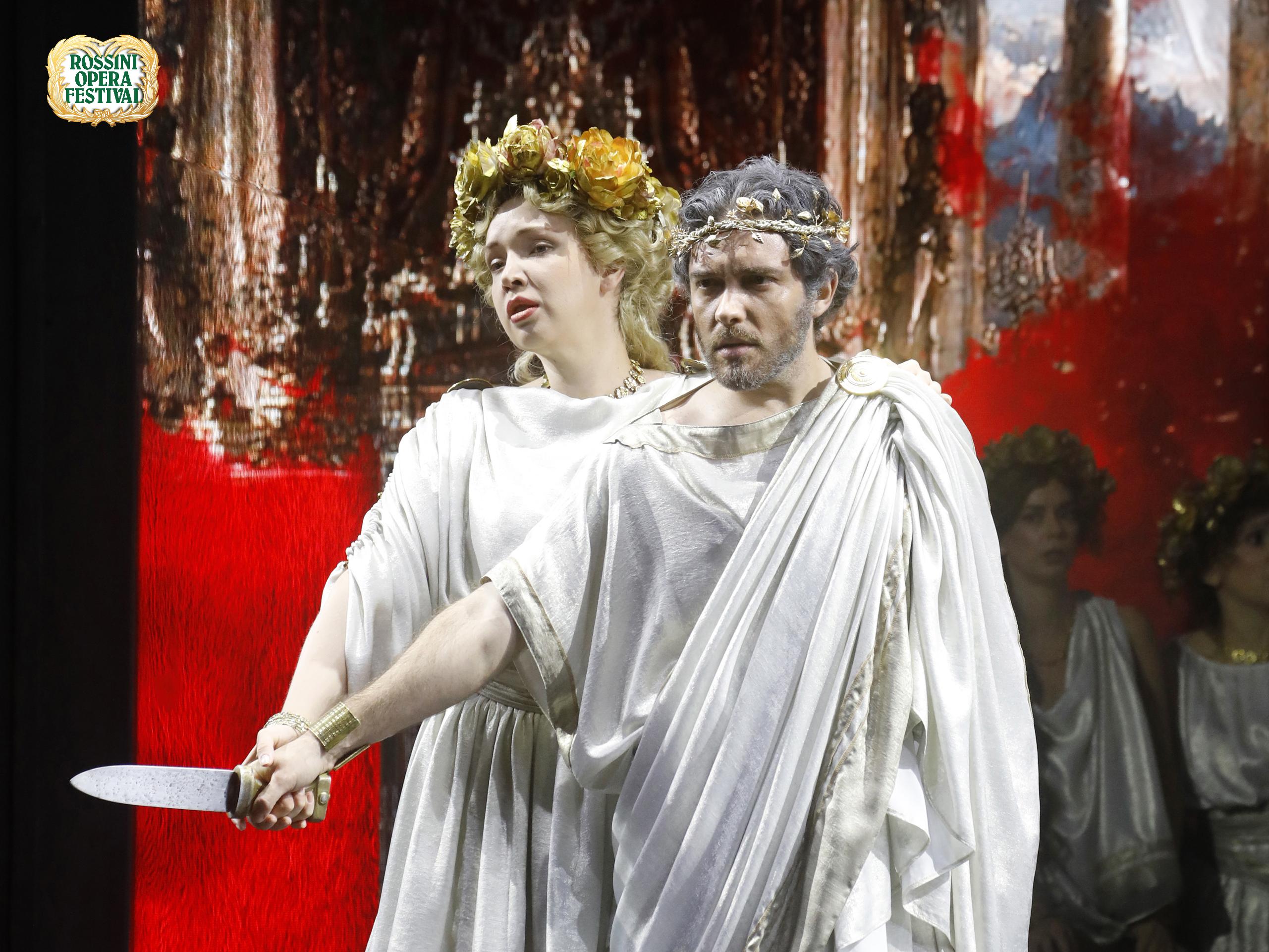
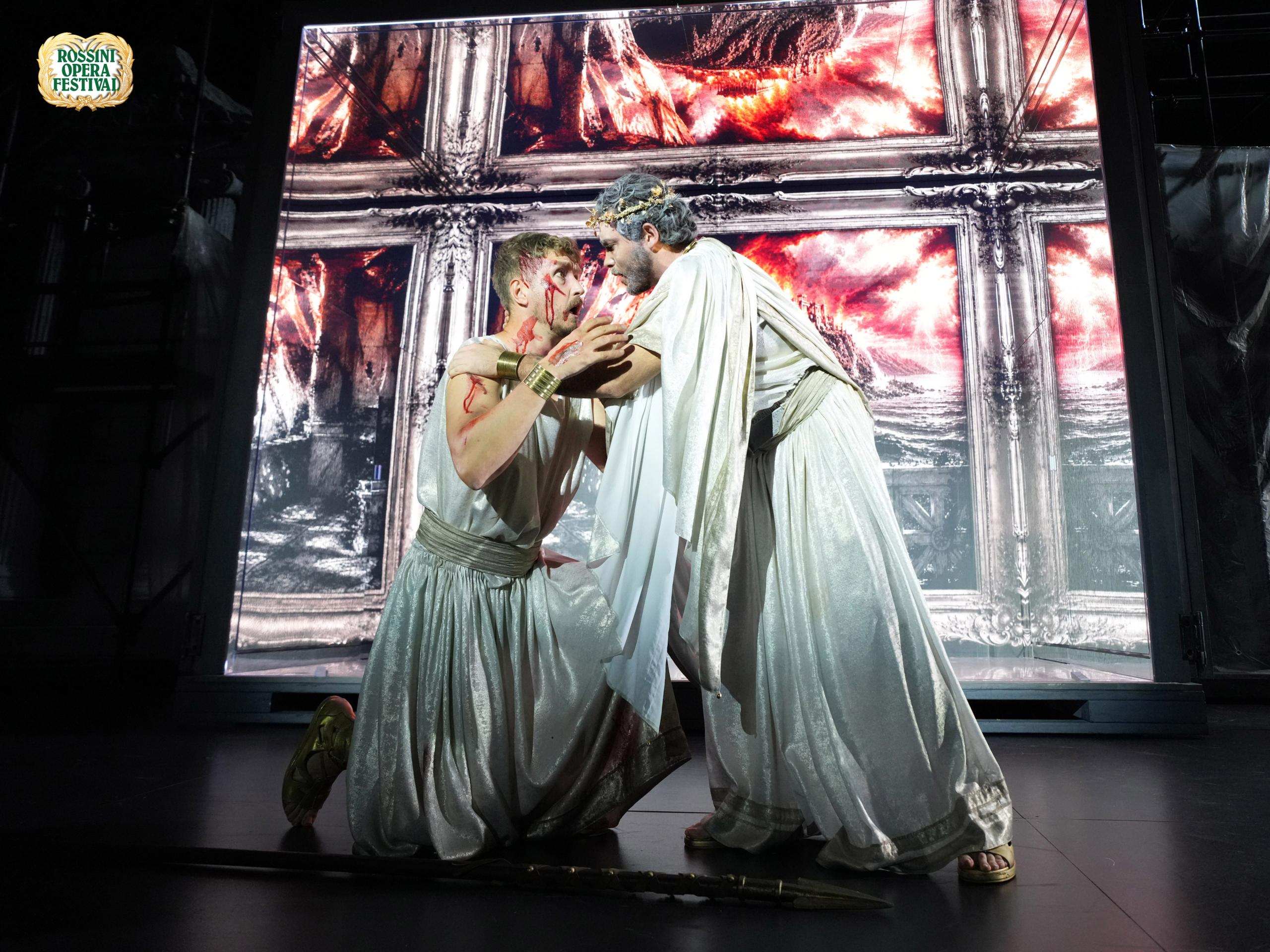
La regia di Davide Livermore si basa su un concept visivo di grande impatto, nel quale il mondo classico e la tecnologia scenica contemporanea dialogano costantemente. La scena è dominata da enormi figure ispirate alla scultura antica, che evocano tanto l’immaginario greco quanto quello romano. Queste forme monumentali, insieme ai riferimenti classici presenti nei costumi, contribuiscono a creare un universo visivo coerente e immediatamente riconoscibile.
A questo impianto si aggiunge il video design di D-Wok, che conferisce alla scenografia un’ulteriore dimensione. Le proiezioni dei paesaggi risultano particolarmente efficaci nel creare la sensazione che un’energia scaturisca dal cuore stesso della scena, tra le gigantesche figure marmoree. Ne nasce un interessante incontro tra la solidità e la permanenza della statuaria classica e la natura mutevole e dinamica delle immagini proiettate. In questo senso, tradizione e modernità non entrano in competizione, ma si completano a vicenda.
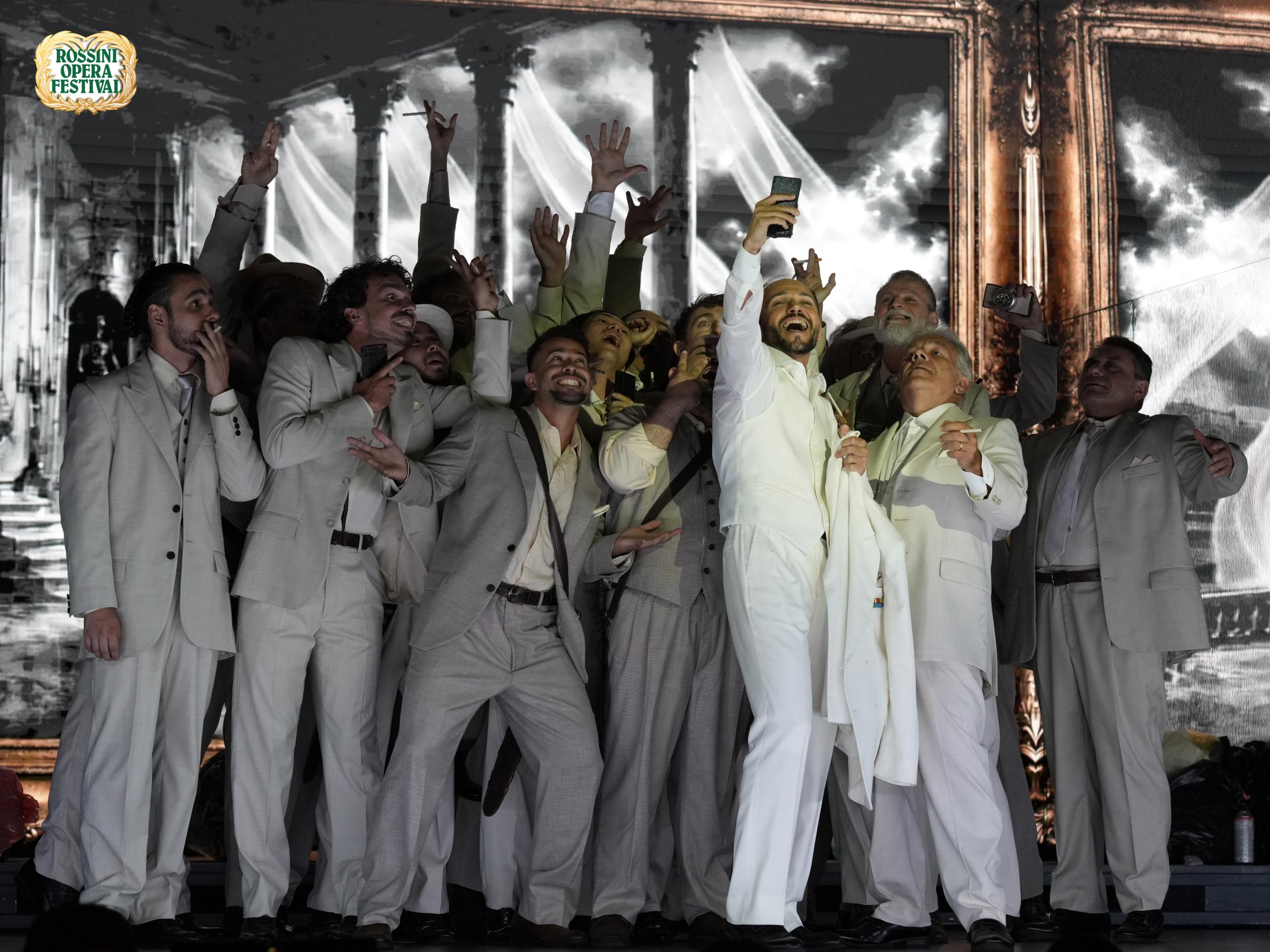
I costumi di Gianluca Falaschi, anch’essi ispirati all’antica Grecia, rafforzano l’estetica complessiva dello spettacolo. Le luci di Nicolas Bovey accompagnano efficacemente l’azione, contribuendo a definire le diverse atmosfere senza mai risultare invasive. La coreografia di Erika Rombaldoni, fortemente influenzata dal linguaggio neoclassico, conferisce invece grande dinamismo alle scene d’insieme. I diversi airs de danse sono inseriti con naturalezza nel flusso drammatico dell’opera.
In buca, l’Orchestra del Teatro Comunale di Bologna dimostra una profonda familiarità con il linguaggio musicale rossiniano. Sotto la direzione di Carlo Rizzi, l’orchestra offre un suono particolarmente rotondo, equilibrato e omogeneo. Una qualità che si rivela particolarmente favorevole alle voci, permettendo ai cantanti di proiettare naturalmente senza dover competere con la massa orchestrale. Rizzi costruisce una sonorità elegante e nitida, preservando al tempo stesso l’energia caratteristica della scrittura di Rossini. Una menzione speciale va anche al Coro del Teatro Ventidio Basso, autore di una prova solida e caratterizzata da una notevole compattezza sonora.
Nel cast, Matteo Roma si distingue nel ruolo di Cléomène. Tra i giovani tenori che stanno attirando l’attenzione sulla scena contemporanea, ha mostrato sicurezza, musicalità e una chiara consapevolezza dello stile. Particolarmente riusciti i suoi interventi nei due trii. È un peccato che il ruolo non preveda una cavatina che gli permetta di mettere maggiormente in luce le proprie qualità. Roma dimostra comunque una solida padronanza dello strumento e una chiara comprensione delle esigenze di questo repertorio.
Nel ruolo di Maometto II, Adrian Sâmpetrean offre una prova convincente, soprattutto dal punto di vista attoriale e della presenza scenica. Si dimostra un interprete preparato, pienamente consapevole delle esigenze teatrali del personaggio. Nella sua cavatina, «Qu’à ma voix la victoire s’arrête… La gloire et la fortune», riesce a conferire al ruolo il necessario peso drammatico.
La vera protagonista della serata è però senza dubbio Vasilisa Berzhanskaya, nel ruolo di Pamyra. La bellezza della sua voce è difficile da descrivere a parole. La sua prova si distingue dall’inizio alla fine. Lo strumento, brillante e straordinariamente ricco di armonici, possiede inoltre una notevole flessibilità, che le consente di affrontare la scrittura rossiniana con un impressionante controllo tecnico e una profonda consapevolezza dello stile.
Berzhanskaya non si limita a mettere in mostra le proprie qualità vocali, ma costruisce una Pamyra profondamente femminile ed espressiva, capace di restituire con grande naturalezza il conflitto emotivo del personaggio. In «Que vais-je devenir?… Ô patrie infortunée» raggiunge uno dei momenti più belli della serata. Altrettanto notevole il duetto con Maometto, «Rassure-toi… Que vois-je! Ô ciel!», nel quale emerge con particolare chiarezza la qualità del dialogo tra le due voci.
Maxim Mironov, nel ruolo di Néoclès, mostra una buona proiezione e affronta con sicurezza le difficoltà del ruolo nell’aria «Grand Dieu, faut-il qu’un peuple». Simon Orfila, nei panni di Hiéros, si distingue sia per la caratterizzazione del personaggio sia per la forza della presenza scenica. Vocalmente, possiede una voce bella, ben timbrata e dotata di notevole proiezione, qualità che conferiscono al personaggio una convincente autorevolezza.
Nei ruoli secondari, Tianxuefei Sun, nei panni di Adraste, e Giuseppe De Luca, in quelli di Omar, assolvono adeguatamente ai rispettivi compiti. Anche Anna-Doris Capitelli, nel ruolo di Ismène, offre una prova solida, caratterizzata da una voce chiara e piacevole.
English: When Rossini presented Le Siège de Corinthe in Paris in 1826, the work was not entirely new. At its core was Maometto II, an opera the composer had premiered in Naples in 1820. However, rather than viewing Le Siège de Corinthe simply as the reuse of an earlier score, it is more appropriate to understand it as a transformation of that work, adapted to a different audience, language, and operatic tradition.
In Maometto II, Rossini had brought to the stage the Ottoman conquest of Negroponte, in present-day Euboea, in 1470. For Paris, he decided to modify both the historical setting and certain dramatic elements. The action was relocated to Corinth, during the Ottoman conquest of 1458, and the result was a French-language work conceived specifically for the grand spectacle of the Théâtre de l’Académie Royale de Musique, now known as the Opéra National de Paris.
The circumstances of Rossini’s arrival in France are also important. When he moved to Paris in 1824, he encountered an operatic world very different from the Italian one he had known until then. The Parisian stage sought to preserve the appeal of the grand historical and spectacular productions that had characterised the early decades of the century, while at the same time searching for new forms and approaches.
Within this context, the figure of Gaspare Spontini, regarded as one of the composers most closely associated with the Napoleonic Empire and, alongside Meyerbeer, one of the figures who helped pave the way for the new genre of grand opéra, had left a particularly important mark. His operas had established a theatrical model of enormous scale, built around large choral forces, solemn dramatic situations, and monumental staging.
The collaboration with the dramatist Alexandre Soumet was fundamental in transforming Maometto II into a work suited to the Parisian stage. Rossini did not simply translate his Italian opera: he reorganised and modified the musical material, introduced new elements, and strengthened those aspects that French audiences expected from a grand opéra. Ballet, choruses, large ensemble scenes, and visual spectacle became fundamental components of the work.
Rossini thus succeeded in bringing together two traditions. On the one hand, he retained elements rooted in his experience of Italian opera: the importance of the vocal line, virtuosity, and writing that was particularly demanding for the singers. On the other, he embraced the scale and conventions of French grand spectacle. The result is therefore not simply a French version of Maometto II, but a work that acquires an identity of its own.
The Cast
The stage production by Davide Livermore for Le Siège de Corinthe is based on a highly striking visual concept, in which the classical and the contemporary are in constant dialogue. The set design is distinguished by the presence of large figures inspired by ancient statuary, evoking both Greek and Roman imagery. These monumental sculptures, together with the classically inspired costumes, create a recognisable visual universe of great beauty.
Added to this concept is the video design by D-Wok, which brings an additional dimension to the stage design. The projections of landscapes work particularly well in creating the sensation that an energy is emerging from the very centre of the stage, among the gigantic marble figures. The result is an interesting combination of the solidity and permanence of classical statuary with the ever-changing and dynamic nature of the projected images. In this sense, tradition and modernity do not compete with one another, but rather complement each other.
The costumes by Gianluca Falaschi, likewise inspired by Greek Antiquity, contribute to the production’s overall aesthetic coherence. The lighting by Nicolas Bovey suitably accompanies the action and helps shape the different atmospheres without imposing itself on the stage. Meanwhile, the choreography by Erika Rombaldoni, strongly neoclassical in character, brings dynamism to the ensemble scenes. The various airs de danse are integrated naturally into the development of the work.
In the pit, the Orchestra of the Teatro Comunale di Bologna demonstrates a profound understanding of the Rossinian repertoire. Under the musical direction of Carlo Rizzi, the orchestra produces a particularly rounded, compact and well-balanced sound. It is precisely this quality that allows the voices to find an appropriate space in which to project without having to compete with the orchestral mass. Rizzi creates an elegant and clearly articulated sound, while respecting the character of Rossini’s musical language. Special mention should also be made of the Coro del Teatro Ventidio Basso.
Among the cast, Matteo Roma stood out particularly as Cléomène, one of the young tenors currently attracting attention on the contemporary scene. His appearances in the two trios were especially impressive, demonstrating security, musicality and an evident command of the style. One regrets that the score does not provide him with a cavatina that would allow his qualities to be appreciated more fully. He is a singer who clearly knows exactly what he is doing and who conveys a remarkable sense of assurance on stage.
As Mahomet II, Adrian Sâmpetrean gave a highly convincing performance from both the theatrical and acting perspectives. He proved himself to be a prepared performer, fully aware of the character’s theatrical demands. In his cavatina, ‘La flamme rapide…’, he successfully conveyed the necessary character and intensity.
But the undisputed triumph of the evening was Vasilisa Berzhanskaya in the role of Pamyra. The beauty of her voice is difficult to put into words. Hers was an outstanding performance from beginning to end. Her instrument, brilliant and extraordinarily rich in harmonics, also possesses a flexibility that enables her to tackle Rossini’s writing with solid technique and a highly developed sense of style.
Berzhanskaya does not merely display her vocal qualities; she also creates a deeply feminine and expressive Pamyra, capable of conveying the character’s emotional conflict with remarkable naturalness. In ‘Ô patrie infortunée’, she reached one of the high points of the performance. Equally remarkable was her duet with Mahomet, ‘Rassure-toi…’, where the dialogue between the two voices made her exceptional qualities even more apparent.
Maxim Mironov, as Néoclès, projected his voice well and responded capably to the demands of his role. Simon Orfila, as Hiéros, stood out both for his characterisation and for the strength of his stage presence. Vocally, he possesses a beautiful, well-focused voice with considerable projection, allowing him to give the character an especially convincing sense of authority.
In the secondary roles, Tianxuefei Sun as Adraste and Giuseppe De Luca as Omar adequately fulfilled their respective roles. Anna-Doris Capitelli, as Ismène, likewise gave a satisfactory performance, with a pleasing and well-supported sound.
Spanish: Cuando Rossini presentó Le Siège de Corinthe en París en 1826, la obra no era completamente nueva. Detrás de ella se encontraba Maometto II, ópera que el compositor había estrenado en Nápoles en 1820. Sin embargo, más que hablar de una simple reutilización de una partitura anterior, conviene entender Le Siège de Corinthe como una transformación de aquella obra para adaptarla a un público, una lengua y una tradición operística diferentes.
En Maometto II, Rossini había llevado a escena la conquista de Negroponte, en la actual isla de Eubea, por las tropas otomanas en 1470. Para París decidió modificar tanto el escenario histórico como determinados elementos dramáticos. La acción pasó a situarse en Corinto, durante la conquista otomana de 1458, y el resultado fue una obra en francés concebida específicamente para el gran espectáculo de la teatro de l’Académie Royale de Musique, o lo que conocemos actualmente como la Opéra National de Paris.
También hay que tener en cuenta el momento en el que Rossini llegó a Francia. Desde su llegada a París en 1824, el compositor se encontró con un mundo operístico diferente del italiano que había conocido hasta entonces. En París se buscaba mantener el atractivo de las grandes producciones históricas y espectaculares que habían marcado las primeras décadas del siglo, pero necesitaba al mismo tiempo encontrar nuevas fórmulas.
En ese panorama, la figura de Gaspare Spontini, (considerado uno de los compositores más importantes asociados al Imperio Napoleónico y que junto con Meyerbeer, dieron paso al nuevo género de Grand Opéra) había dejado una huella especialmente importante. Sus óperas habían establecido un modelo de enorme dimensión teatral, basado en grandes masas corales, situaciones solemnes y una puesta en escena monumental.
La colaboración con el dramaturgo Alexandre Soumet fue fundamental para convertir Maometto II en una obra adecuada para el escenario parisino. Rossini no se limitó a traducir su ópera italiana: reorganizó y modificó el material musical, incorporó elementos nuevos y reforzó aquellos aspectos que el público francés esperaba encontrar en una grand opéra. El ballet, los coros, las grandes escenas colectivas y la espectacularidad visual pasaron a ocupar un lugar fundamental.
Así pues Rossini consigue combinar dos tradiciones. Por un lado, mantiene elementos que proceden de su experiencia en la ópera italiana: la importancia de la línea vocal, el virtuosismo y una escritura especialmente exigente para los cantantes. Por otro, adopta las dimensiones y las convenciones del gran espectáculo francés. El resultado no es, por tanto, una simple versión francesa de Maometto II, sino una obra que adquiere una identidad propia.
El Cast
La propuesta escénica de Davide Livermore para Le Siège de Corinthe parte de una concepción visual de gran impacto, en la que lo clásico y lo contemporáneo dialogan constantemente. La escenografía destaca por la presencia de grandes figuras inspiradas en la estatuaria de la antigüedad, que evocan tanto el imaginario griego como el romano. Estas esculturas monumentales, junto con el vestuario de inspiración clásica, construyen un universo visual reconocible y de gran belleza.
A este planteamiento se suma el videodesign de D-Wok, que aporta una dimensión adicional a la escenografía. Las proyecciones de paisajes funcionan especialmente bien al generar la sensación de que una energía emerge del propio centro del escenario, entre las gigantescas figuras de mármol. El resultado es una interesante combinación entre la solidez y permanencia de la estatuaria clásica y el carácter cambiante y dinámico de las imágenes proyectadas. En este sentido, se consigue que la tradición y la modernidad no compitan entre sí, sino que se complementen.
El vestuario de Gianluca Falaschi, inspirado igualmente en la Antigüedad griega, contribuye a la coherencia estética de la producción. Las luces de Nicolas Bovey acompañan adecuadamente la acción y ayudan a modelar los diferentes ambientes sin imponerse sobre la escena. Por su parte, las coreografías de Erika Rombaldoni, de marcado carácter neoclásico, aportan dinamismo a los momentos colectivos. Los distintos airs de danse se integran con naturalidad en el desarrollo de la obra.
En el foso, la Orchestra del Teatro Comunale di Bologna demuestra conocer profundamente el repertorio rossiniano. Bajo la dirección musical de Carlo Rizzi, la orquesta ofrece un sonido particularmente redondo, compacto y equilibrado. Es precisamente esta cualidad la que permite que las voces encuentren un espacio adecuado para proyectarse sin necesidad de luchar contra la masa orquestal. Rizzi construye una sonoridad elegante y bien articulada, respetando el carácter del lenguaje de Rossini. También merece una mención especial el Coro del Teatro Ventidio Basso.
Entre las voces del reparto destacó especialmente Matteo Roma como Cléomène, uno de los jóvenes tenores que llama la atención en el panorama actual. Su intervención en los dos tríos fue especialmente destacable, demostrando seguridad, musicalidad y un dominio evidente del estilo. Se echa en falta que la partitura no le reserve una cavatina que permita apreciar con mayor amplitud sus cualidades vocales. Es un cantante que sabe perfectamente lo que hace y que transmite una notable sensación de seguridad sobre el escenario.
Como Mahomet II, Adrian Sâmpetrean ofreció una interpretación muy convincente desde el punto de vista escénico y actoral. Se mostró como un intérprete preparado y consciente de las exigencias teatrales del personaje. En su cavatina, ‘La flamme rapide’, supo imprimir al personaje el carácter necesario.
Pero la gran triunfadora de la velada fue, sin duda, Vasilisa Berzhanskaya en el papel de Pamyra. La belleza de su voz resulta difícil de explicar con palabras. Fue una interpretación de excelencia de principio a fin. Su instrumento, brillante y extraordinariamente rico en armónicos, posee además una flexibilidad que le permite abordar la escritura de Rossini con una técnica sólida y un sentido del estilo muy desarrollado.
Berzhanskaya no se limita a exhibir sus cualidades vocales: construye además una Pamyra profundamente femenina y expresiva, capaz de transmitir con enorme naturalidad el conflicto emocional del personaje. En ‘Ô patrie infortunée’ alcanzó uno de los momentos culminantes de la representación. Igualmente notable fue su dúo con Mahomet, ‘Rassure-toi…’, donde el diálogo entre ambas voces permitió apreciar todavía más sus excelentes condiciones.
Maxim Mironov, como Néoclès, ofreció una buena proyección y respondió con solvencia a las exigencias de su papel. Simon Orfila, en el papel de Hiéros, destacó tanto por la caracterización del personaje como por la fuerza de su presencia escénica. Vocalmente posee una voz preciosa, bien timbrada y de gran proyección, que le permite dotar al personaje de una autoridad especialmente convincente.
En los papeles secundarios, Tianxuefei Sun como Adraste y Giuseppe De Luca como Omar cumplieron correctamente con sus cometidos. Anna-Doris Capitelli, como Ismène, ofreció igualmente una actuación correcta, con buena sonoridad.
Photo credits: Amati Bacciardi | Rossini Opera Festival