
English: The International Festival of Contemporary Music ENSEMS reaches its 48th edition in 2026, with a history spanning almost half a century, and continues to establish itself as one of the key spaces for contemporary sound creation. Founded in 1978, the festival has developed its own territory, where thought, experimentation and performance coexist, and where the music of our time finds a space in which to be heard, discussed and confronted with the present. This long trajectory has also helped position València as one of the centres of contemporary musical creation.
For more than a decade, ENSEMS has supported new operatic creation, particularly chamber opera formats, a field that, because of its relatively specialised nature and the complexity of its production processes, can hardly develop without institutional support. Rather than understanding opera as a genre closed within its own tradition, the festival has turned it into a space for experimentation, where music, dramaturgy, stage space and new technologies can establish new relationships.
This commitment has taken shape in works such as Zelle, wenn es dunkel wird, by Jamie Man, premiered as part of the 44th edition of ENSEMS in 2022; Woman at Point Zero, by Bushra El-Turk, which opened the 45th edition at Les Arts in 2023 as the result of a collaboration between ENSEMS, Les Arts and ENOA; and The Golden Stool, by Gorges Ocloo, presented as part of the 46th edition in 2024. The 48th edition features two operatic works: Estètica i massacre, by Carles Prat, and Einstein on the Beach, by Philip Glass.
This commitment takes on a particular dimension in the present edition under the direction of Beatriz Traver i Badenes, Deputy Director of Music and Traditional Culture at the Institut Valencià de Cultura. The discourse surrounding the festival begins with a question that is particularly pertinent to contemporary music: the criticism of music’s transformation into a fast-consumption product, subject to the logic of cultural “fast food”, raises an issue that directly affects contemporary opera.
INSTITUTIONAL COLLABORATION
The relationship between ENSEMS and Les Arts has now developed into an established partnership and has acquired increasing significance within Valencia’s musical landscape. The encounter between the festival and Valencia’s principal opera house allows works conceived through contemporary languages to find an appropriate production and performance structure, while bringing proposals into the operatic circuit that would otherwise struggle to find a place within a conventional programme. Les Arts therefore broadens the reach of ENSEMS’s commitment to new creation, while the festival offers the opera house an opportunity to explore less familiar territories.
What might initially have been understood as a collaboration between two institutions with different responsibilities and audiences has progressively become a space for dialogue around a shared question: how can the musical creation of our time find its own place before the public?
The Les Arts building itself, conceived as an architectural emblem of contemporary Valencia, provides a particularly suggestive setting for music that seeks to explore new forms of expression. Within this context, contemporary creation ceases to occupy a peripheral position and moves into the very heart of Valencia’s operatic institution.
The commitment of its artistic director, Jesús Iglesias Noriega, to incorporating contemporary creation into the artistic discourse of Les Arts acquires particular significance as the 2026–2027 opera season opens precisely with Estètica i massacre, within the framework of ENSEMS. These gestures towards contemporary creation are also worthy of recognition as part of Iglesias’s artistic direction and his commitment to new opera. An example came in the previous 2025–2026 season with Enemigo del pueblo, by Valencian composer Francisco Coll, a co-production and commission by Les Arts and the Teatro Real, which also received its world premiere at the Valencian opera house. The inclusion of Estètica i massacre now reinforces a conception of opera not as a museum genre, but as a living territory.
The gesture has an evident symbolic dimension: an opera house opens its season without looking exclusively towards established repertoire, thereby understanding the operatic institution as a living organism.
ESTÈTICA I MASSACRE
Estètica i massacre is a chamber opera with music by Carles Prat and a libretto by Carlota Gurt, born within the framework of the Òh!pera project at the Gran Teatre del Liceu. The work premiered at the Liceu on 25 July 2025 in an initial version lasting approximately thirty minutes. Prat and Gurt subsequently expanded the piece with a second act, transforming it into a chamber opera of approximately one hour. It is this new version that arrives at Les Arts and the ENSEMS festival in 2026, after also being presented at the Ópera a Quemarropa festival, at the Teatro de San Lorenzo de El Escorial, and at the Festival de Peralada.
Through a satirical and deliberately hyperbolic language, the piece explores a paradox that is both contemporary and uncomfortable: to what extent are we capable of violating our own identity in order to gain the acceptance of others? The “massacre” in the title is, above all, an intimate massacre: the destruction that takes place when the need to be seen, accepted and validated ultimately transforms who we are.
In Estètica i massacre, music and stage action establish a close dialogue from the outset. Carles Prat’s score reveals a deep understanding of the voice and its dramatic possibilities. His experience in the choral field can be perceived in a writing particularly attentive to vocal treatment, in which the music does not function as mere accompaniment but breathes together with the text and the stage action.
Prat thus constructs an essentially theatrical music, direct and immediate, capable of reinforcing different emotional states without ever losing its dramatic purpose. The chamber format proves particularly well suited to this approach, establishing a close relationship with the voices and allowing the different layers of the sound world to be heard with precision. Pablo Meléndez, on piano; Álvaro Rodríguez, on clarinet; Clàudia López, on violin; and Jorge Bosch, on percussion, form a solid ensemble, attentive to the demands of the stage and capable of maintaining an effective balance with the voices.
If the music provides the work’s inner pulse, Oriol Pla’s stage direction reinforces its theatrical dimension. His production is dynamic, physical and immediate, deliberately avoiding any operatic solemnity. Pla understands that this story requires direct communication with the audience and creates a staging that seeks to establish a connection with contemporary spectators. Movement, rhythm and the proximity of the performers help transform the stage into a recognisable territory.
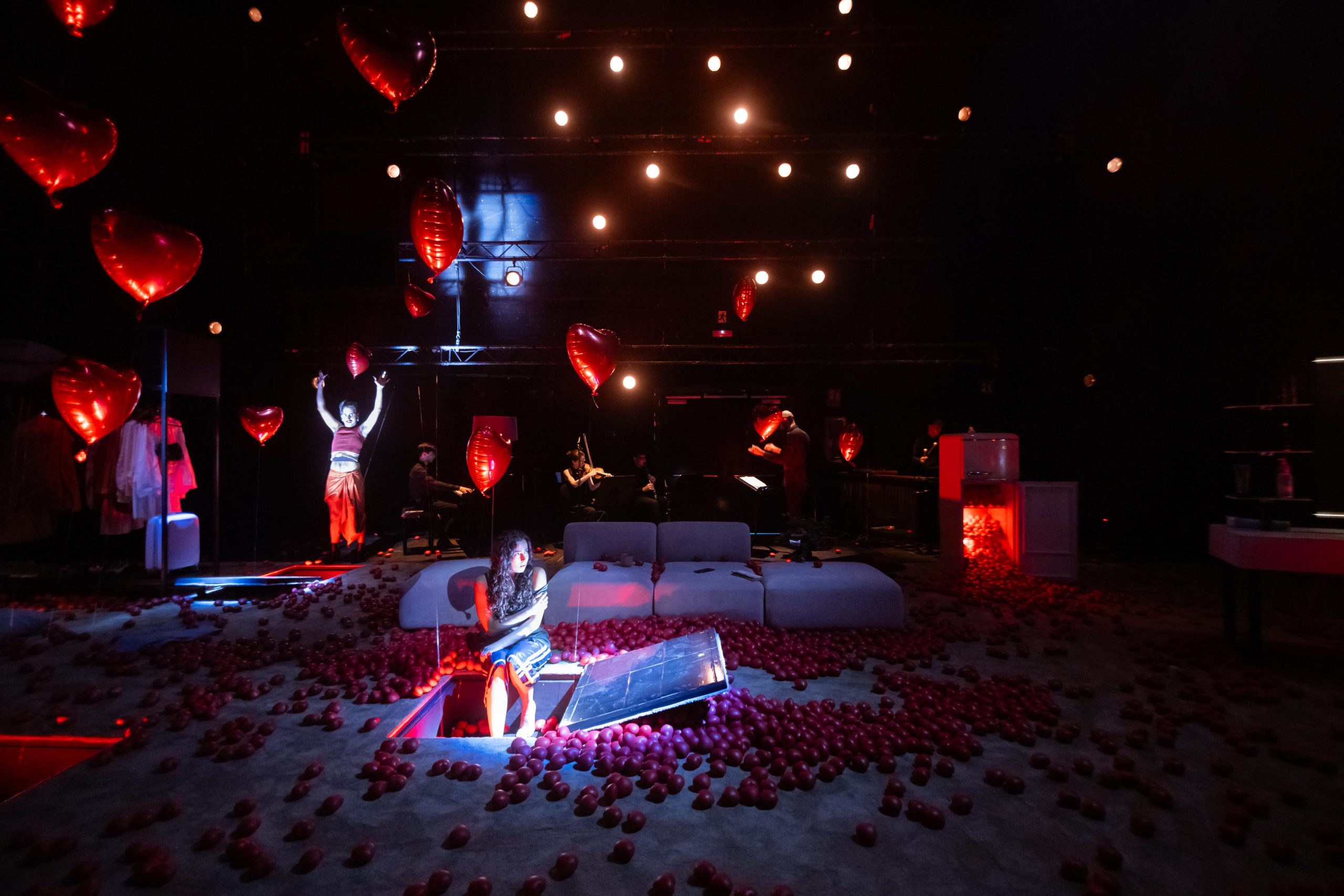
Josep Iglesias’s set design reinforces this reading. Simple in its elements but rich in symbolic possibilities, it finds one of its most intelligent devices in the small red balls. Turned into a visual representation of social-media likes, they become a stage translation of the contemporary need for approval. Within the same visual universe, Alba Semper’s costumes are coherent with the scenographic proposal and naturally integrated into the whole. Mariona Ubia’s lighting, meanwhile, accompanies the space without overwhelming it and helps define the different atmospheres of the performance. Costume, lighting and set design thus share a common aesthetic conception without competing with either the music or the performers.
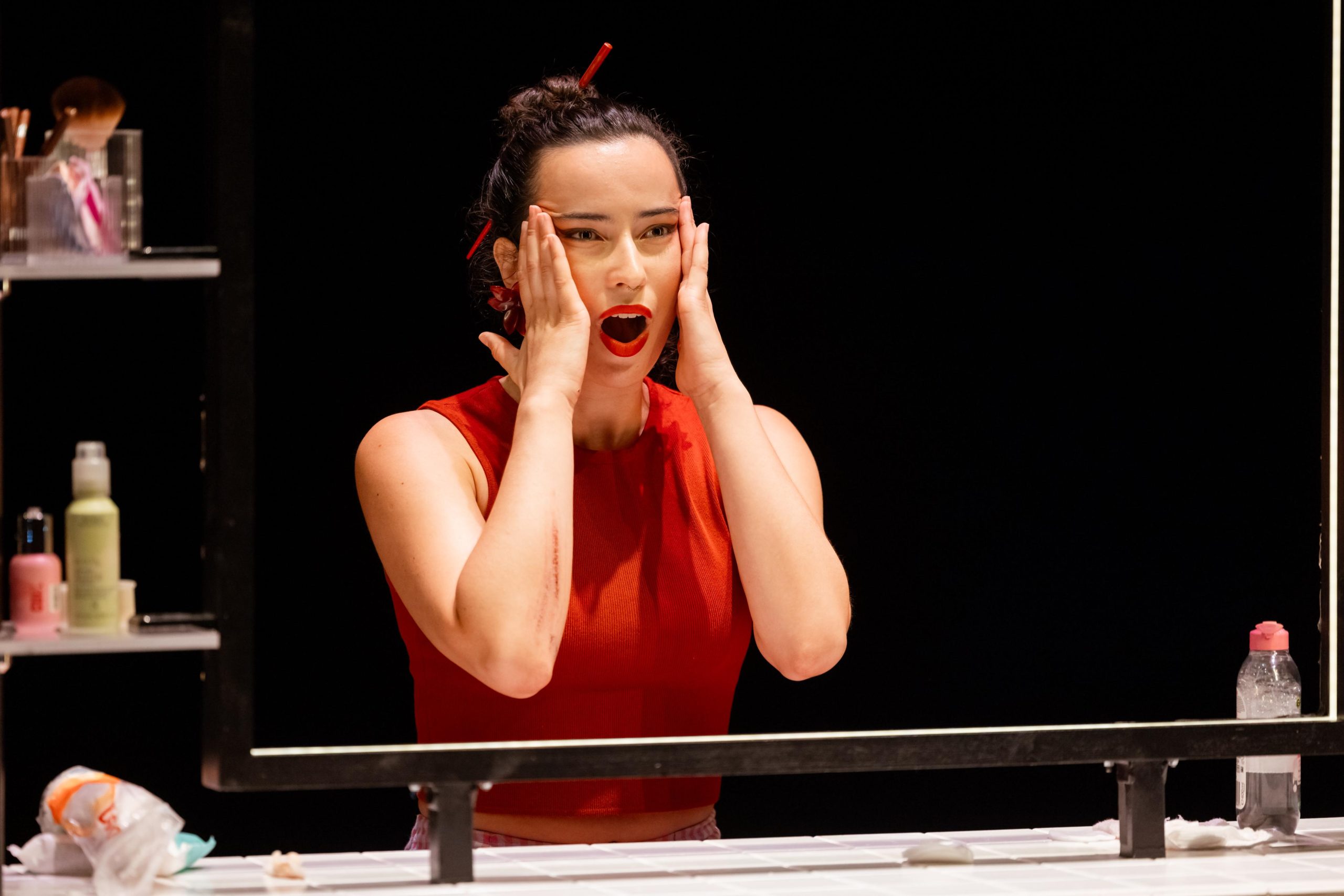
Vocally, soprano Maria Patak builds a markedly realistic interpretation. Her approach to the character avoids excess and opts for a direct expressiveness that fits particularly well with the work’s intention to present the audience with a situation that, beneath its hyperbolic appearance, is disturbingly recognisable. Patak succeeds in ensuring that the character’s inner conflict is never subordinated to the stage artifice.
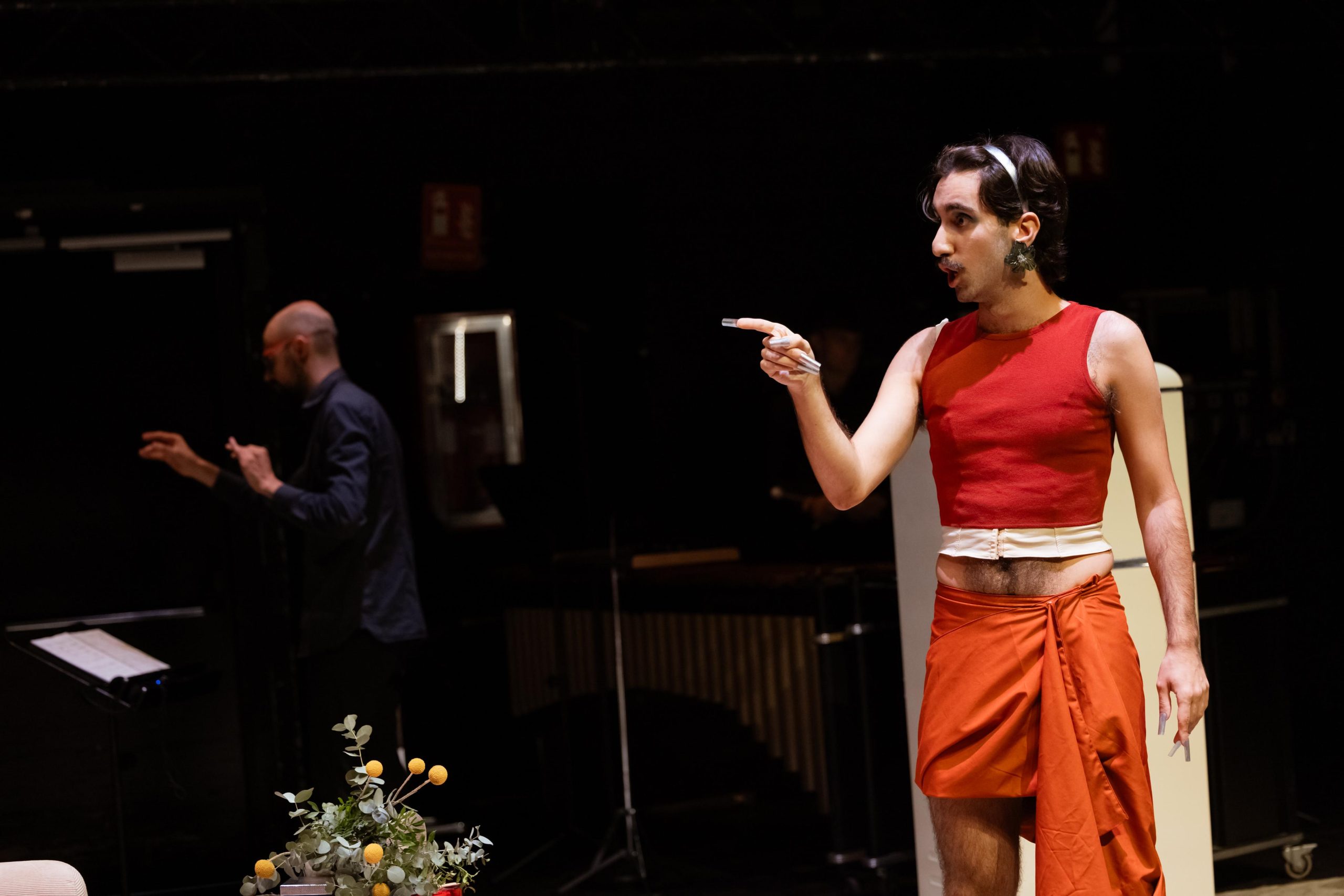
Baritone Carlos Varela stands out particularly for the clarity and excellent articulation of the text. The spoken word acquires considerable dramatic weight in his interpretation and reaches the audience with precision without losing expressiveness. His stage presence likewise contributes to maintaining the balance between the theatrical and musical dimensions of the production.
One of the principal strengths of Estètica i massacre is, ultimately, its understanding that the contemporaneity of opera depends not only on the novelty of its musical language, but also on its ability to address the tensions of the present and to find an appropriate theatrical form through which to do so. Here, Prat’s music, Gurt’s libretto and Pla’s stage direction engage with a reality shaped by images, hyper-exposure and the constant need for validation.
The reduced means of chamber opera do not entail a reduction in quality. On the contrary, the proximity between musicians, singers and audience intensifies the experience, giving it a more immediate dimension. Estètica i massacre finds one of its principal virtues precisely in this proximity: transforming contemporary life into a mirror in which the spectator can recognise themselves.
Spanish: El Festival Internacional de Música Contemporánea ENSEMS alcanza en su 48.ª edición con una trayectoria de casi medio siglo y se reafirma como uno de los espacios de referencia para la creación sonora contemporánea. Desde su fundación en 1978, el festival ha construido un territorio propio en el que pensamiento, experimentación e interpretación conviven y en el que la música de nuestro tiempo encuentra un espacio para ser escuchada, discutida y confrontada con el presente. Una trayectoria que ha contribuido, además, a situar València como uno de los focos de la creación musical contemporánea.
ENSEMS lleva más de una década apostando por la nueva creación lírica y, especialmente, por los formatos de ópera de cámara, un ámbito que por su carácter minoritario y por la complejidad de sus procesos de producción difícilmente puede desarrollarse al margen del apoyo institucional. Lejos de entender la ópera como un género cerrado sobre su propia tradición, el festival la ha convertido en un territorio de experimentación en el que música, dramaturgia, espacio escénico y nuevas tecnologías pueden establecer relaciones diferentes.
Esta apuesta se ha materializado en títulos como Zelle, wenn es dunkel wird, de Jamie Man, estrenada en el marco de la 44.ª edición de ENSEMS en 2022; Woman at Point Zero, de Bushra El-Turk, que inauguró la 45.ª edición en Les Arts en 2023, fruto de la colaboración entre ENSEMS, Les Arts y ENOA; o The Golden Stool, de Gorges Ocloo, incorporada a la programación de la 46.ª edición en 2024. Esta 48.ª edición apuesta por dos títulos operísticos: Estètica i Massacre de Carles Prat y Einstein on the Beach de Philip Glass.
Esta línea adquiere una dimensión particular en la presente edición, bajo la dirección de Beatriz Traver i Badenes, directora adjunta de Música y Cultura Popular del Institut Valencià de Cultura. El discurso que acompaña al festival parte de una cuestión especialmente pertinente para la música contemporánea: La crítica a la conversión de la música en un producto de consumo rápido, sometido a una lógica de «fast food» cultural, plantea una cuestión que afecta de manera directa a la ópera contemporánea.
COLABORACIÓN INSTITUCIONAL
La relación entre ENSEMS y Les Arts cuenta ya con una trayectoria consolidada y ha ido adquiriendo una dimensión cada vez más significativa dentro del panorama musical valenciano. El encuentro entre el festival y el principal espacio lírico valenciano permite que obras concebidas desde lenguajes contemporáneos encuentren una estructura de producción y exhibición adecuada, al tiempo que introduce en el circuito operístico propuestas que difícilmente tendrían cabida en una programación convencional. La presencia de Les Arts amplía así el alcance de la apuesta de ENSEMS por la nueva creación, mientras el festival ofrece al teatro lírico un espacio para explorar territorios menos transitados.
Lo que podría entenderse inicialmente como una colaboración entre dos instituciones con responsabilidades y públicos diferentes se ha convertido progresivamente en un espacio de diálogo en torno a una cuestión común: cómo hacer que la creación musical de nuestro tiempo encuentre un lugar propio ante el público.
El propio edificio de Les Arts, concebido como un emblema arquitectónico de la contemporaneidad valenciana, establece un marco particularmente sugerente para una música que busca explorar nuevas formas de expresión. En ese contexto, la creación contemporánea deja de ocupar un espacio periférico para situarse en el corazón mismo de la institución operística valenciana.
La apuesta de su director artístico, Jesús Iglesias Noriega, por incorporar la creación actual al discurso de Les Arts adquiere especial significado al iniciar la temporada operística 2026-2027 precisamente con Estètica i massacre, en el marco del festival ENSEMS. Estos gestos hacia las vanguardias son también dignos de reconocimiento en la dirección de Iglesias y en su apuesta por la creación lírica contemporánea. Un ejemplo fue en la anterior temporada 2025-2026 con Enemigo del pueblo, del compositor valenciano Francisco Coll, una cooproducción y encargo de Les Arts con el Teatro Real, que además fue estreno absoluto en la ópera valenciana. La incorporación ahora de Estètica i massacre refuerza una concepción de la ópera que no la entiende como un género de museo, sino como un territorio vivo.
El gesto tiene una evidente dimensión simbólica: un teatro de ópera abre su temporada no mirando exclusivamente hacia el repertorio consolidado, por tanto, se entiende así la institución lírica como un organismo vivo.
ESTÈTICA I MASSACRE
Estètica i massacre, es una ópera de cámara con música de Carles Prat y libreto de Carlota Gurt, nacida en el marco del proyecto Òh!pera del Gran Teatre del Liceu. La obra se estrenó el 25 de julio de 2025 en el Liceu, en una primera versión de unos treinta minutos. Posteriormente, Prat y Gurt ampliaron la pieza con un segundo acto hasta convertirla en una ópera de cámara de aproximadamente una hora. Es esta nueva versión la que llega en 2026 a Les Arts y al festival ENSEMS, después de haber pasado también por el festival Ópera a Quemarropa, en el Teatro de San Lorenzo de El Escorial, y por el Festival de Peralada.
La pieza plantea, mediante un lenguaje satírico y deliberadamente hiperbólico, una paradoja tan contemporánea como incómoda: ¿hasta qué punto somos capaces de violentar nuestra propia identidad para conseguir la aceptación de los demás? La «masacre» del título es, sobre todo, una masacre íntima, la que se produce cuando la necesidad de ser vistos, aceptados y validados termina transformando nuestra manera de ser.
En Estètica i massacre, música y escena establecen desde el primer momento un diálogo estrecho. La composición de Carles Prat revela un conocimiento profundo de la voz y de sus posibilidades dramáticas. Su experiencia en el ámbito coral se percibe en una escritura especialmente atenta al tratamiento vocal, en la que la música no funciona como un simple acompañamiento, sino que respira con el texto y con la acción escénica.
Prat construye así una música eminentemente teatral, directa y cercana, capaz de reforzar los diferentes estados emocionales sin perder nunca su función dramática. En este sentido, el formato de cámara le resulta especialmente adecuado, se establece una relación muy próxima con las voces y permiten una escucha detallada de los diferentes planos sonoros. Pablo Meléndez, al piano; Álvaro Rodríguez, al clarinete; Clàudia López, al violín, y Jorge Bosch, en la percusión, conforman un conjunto solvente, atento a las necesidades de la escena y capaz de mantener un equilibrio adecuado con las voces.
Si la música aporta el nervio interno de la obra, la dirección escénica de Oriol Pla acentúa su componente teatral. Su propuesta es dinámica, física e inmediata, y huye deliberadamente de cualquier solemnidad operística. Pla entiende que esta historia necesita una comunicación directa con el espectador y construye una puesta en escena que busca la identificación con un público contemporáneo. El movimiento, el ritmo y la proximidad de los intérpretes contribuyen a convertir el espacio escénico en un territorio reconocible.
La escenografía de Josep Iglesias refuerza esta lectura. Sencilla en sus elementos pero rica en posibilidades simbólicas, encuentra en las pequeñas bolas rojas uno de sus recursos más inteligentes. Convertidas en una representación visual de los likes en redes sociales, funcionan como una traducción escénica de la necesidad contemporánea de aprobación. En este mismo universo visual se inscribe el vestuario de Alba Semper, coherente con la propuesta escenográfica e integrado con naturalidad en el conjunto. La iluminación de Mariona Ubia, por su parte, acompaña el espacio sin sobrecargarlo y contribuye a definir las diferentes atmósferas de la representación. Vestuario, luz y escenografía comparten así una misma concepción estética, sin que ninguno de estos elementos compita con la música o con los intérpretes.
En el terreno vocal, Maria Patak, soprano, construye una interpretación de carácter marcadamente realista. Su aproximación al personaje evita el exceso y apuesta por una expresividad cercana, que encaja especialmente bien con la voluntad de la obra de trasladar al público una situación que, bajo su apariencia hiperbólica, resulta inquietantemente reconocible. Patak consigue que el conflicto interior del personaje no quede subordinado al artificio escénico.
Carlos Varela, barítono, destaca especialmente por la claridad y la excelente articulación del texto. La palabra adquiere en su interpretación un importante peso dramático y llega al público con precisión, sin perder expresividad. Su presencia escénica contribuye igualmente a mantener el equilibrio entre el componente teatral y el musical de la propuesta.
Uno de los principales aciertos de Estètica i massacre es, en definitiva, entender que la contemporaneidad de la ópera no depende únicamente de la novedad del lenguaje musical, sino también de la capacidad de hablar de las tensiones del presente y de encontrar una forma escénica adecuada para hacerlo. Aquí, la música de Prat, el libreto de Gurt y la propuesta de Pla dialogan con una realidad marcada por la imagen, la hiperexposición y la necesidad constante de validación.
La reducción de medios propia de la ópera de cámara no comporta una reducción de calidad. Al contrario, la proximidad entre músicos, cantantes y espectadores intensifica la experiencia. Adquiere una dimensión más inmediata. Estètica i massacre encuentra precisamente en esta proximidad una de sus principales virtudes: convertir la contemporaneidad en un espejo en el que el espectador puede reconocerse.