
THE FESTIVAL
2026: 103rd Arena Opera Festival 2026.
In 1913, the tenor Giovanni Zenatello (1876–1949), who had already created roles for Puccini, Giordano, Cilea and other composers, and was still at the beginning of his career, had the vision of bringing opera to the Arena of Verona, his hometown. Performances had already taken place there in the 19th century, although sporadically and without continuity, within a thousand-year history that had seen all kinds of spectacles pass through the amphitheatre. The idea — and the financial risk — was shared with the impresario Ottone Rovato, with the support of the maestros Ferruccio Cusinati and Tullio Serafin, as well as the now legendary acoustic test carried out with a coin, whose sound could be heard perfectly from different points of the Arena.
A major performance was needed to celebrate the centenary of Giuseppe Verdi’s birth, and the choice fell on Aida, which premiered on 10 August 1913, with Serafin on the podium and Zenatello in the role of Radamès. The media attention and resounding success led to a new season the following summer, with a new title, Carmen, and many subsequent editions, although continuity was interrupted by the two World Wars.
As a singer, Giovanni Zenatello was active from 1898 to 1933. After beginning as a baritone, he became one of the most sought-after tenors of his time, with a repertoire of more than forty roles. Considered a rival of Caruso — with whom, nevertheless, he maintained a sincere friendship — he was greatly loved in his own country and even more so abroad. Throughout his life, he discovered talents and helped young colleagues take their first steps, among them Miguel Fleta, Lily Pons and Nino Martini.
It is beautiful to remember that, precisely after the hardships of the war, it was once again Zenatello and Serafin who took the reins of the Festival in 1947, during the second edition held after the war, looking confidently towards the future and taking a chance on the then-unknown Maria Callas.
Through lectures, special dedications, an exhibition and a publication, the Fondazione Arena di Verona once again remembers him in 2026 with admiration and gratitude, 150 years after his birth.
Text by Arena di Verona
AIDA
Aida was born in a context of enormous cultural and political ambition. The Khedive of Egypt, Ismail Pasha, commissioned Verdi to write a new opera for the Khedivial Opera House in Cairo, as part of the modernization and Europeanization project that was transforming the city. The plot, inspired by an idea attributed to the French Egyptologist Auguste Mariette, was set in ancient Egypt and offered Verdi the opportunity to combine grand spectacle with a drama of profound human dimensions.
The opera finally premiered on 24 December 1871 in Cairo, conducted by Giovanni Bottesini, after various delays caused, among other circumstances, by the Franco-Prussian War, which had prevented the sets and costumes made in Paris from being transported to Egypt. Verdi did not attend the premiere. Moreover, he was not entirely satisfied with the circumstances surrounding that first performance, whose audience was composed mainly of invited dignitaries, politicians and critics. For this reason, he regarded the premiere at La Scala in Milan, on 8 February 1872, as the true presentation of the work to the European public.
The Cairo premiere was nevertheless a great success. The production had been conceived with extraordinary visual richness, under the supervision of Mariette, who was also responsible for the designs of the sets, costumes and accessories. The spectacular nature of the staging was perfectly in keeping with the monumental conception of the score.
The subsequent critical reception was somewhat more complex. In Milan, the audience welcomed Aida with enormous enthusiasm, but some critics expressed reservations about a score that combined the tradition of Italian opera with elements associated with the so-called “modern school,” including influences from Meyerbeer, Gounod and Wagner. In particular, there was discussion about the balance between traditional Italian melody and a more sophisticated orchestral writing, as well as the increasing dramatic continuity of Verdi’s music.
This issue is fundamental to understanding Aida. Verdi, far from simply writing a spectacular grand opéra set in Egypt, had reached a stage of full artistic maturity. The great choral and ceremonial scenes coexist with increasingly refined intimate and psychological writing. The Triumphal March represents the power and public dimension of the Egyptian state; “Celeste Aida,” “Ritorna vincitor!” and “O patria mia,” on the other hand, reveal the inner conflict of characters caught between love, duty, homeland and power.
More than a century later, the choice of Aida to inaugurate the operatic tradition of the Arena di Verona in 1913 thus takes on an almost inevitable dimension. The monumental architecture of the amphitheatre visually extends what Verdi had conceived musically: an opera capable of bringing together crowds, ceremonies and spectacle without relinquishing the intimacy of a human tragedy. The Arena transformed that monumental dimension into one of its defining characteristics and, ever since, Aida has remained deeply connected to the history of the Veronese amphitheatre.
CAST
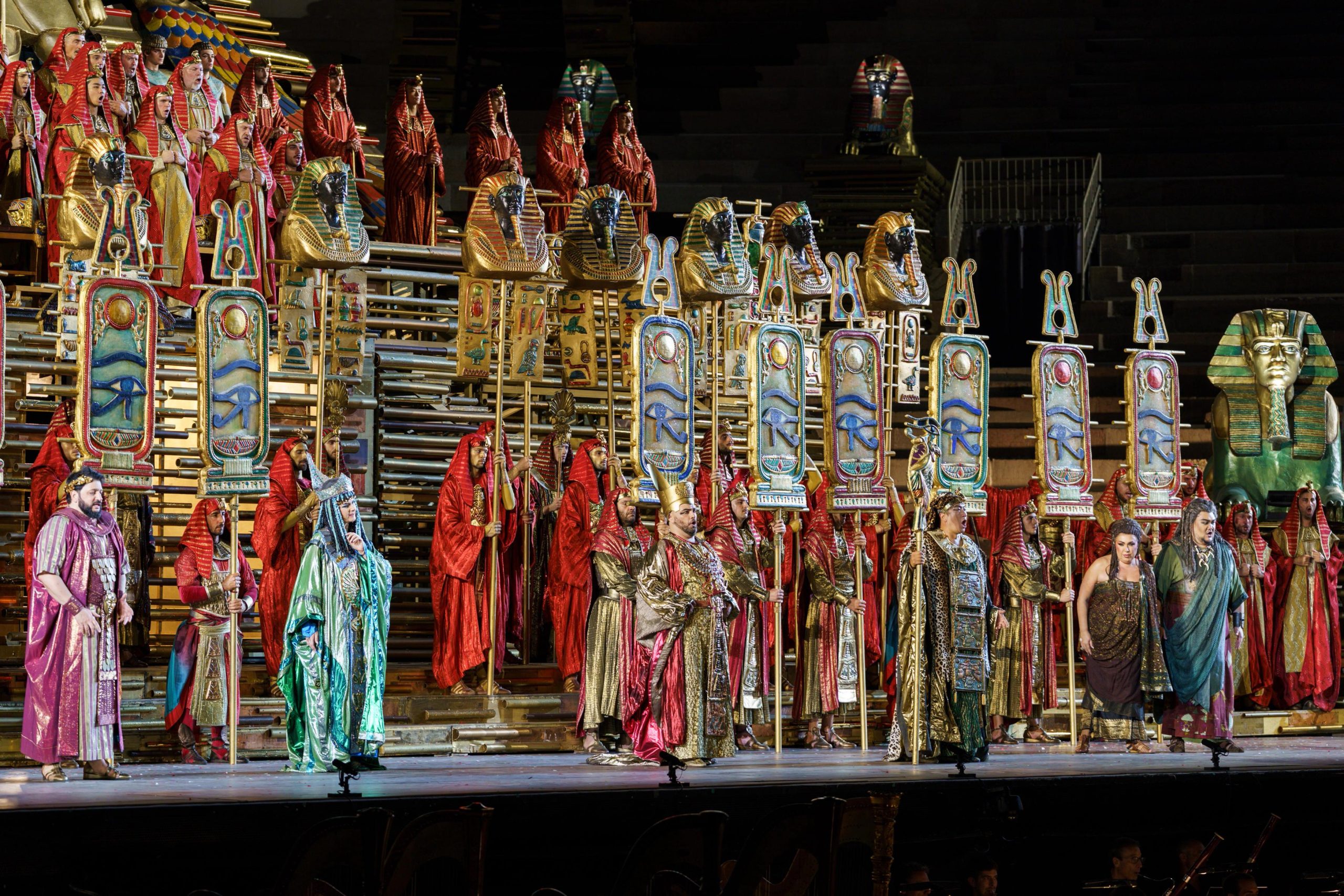
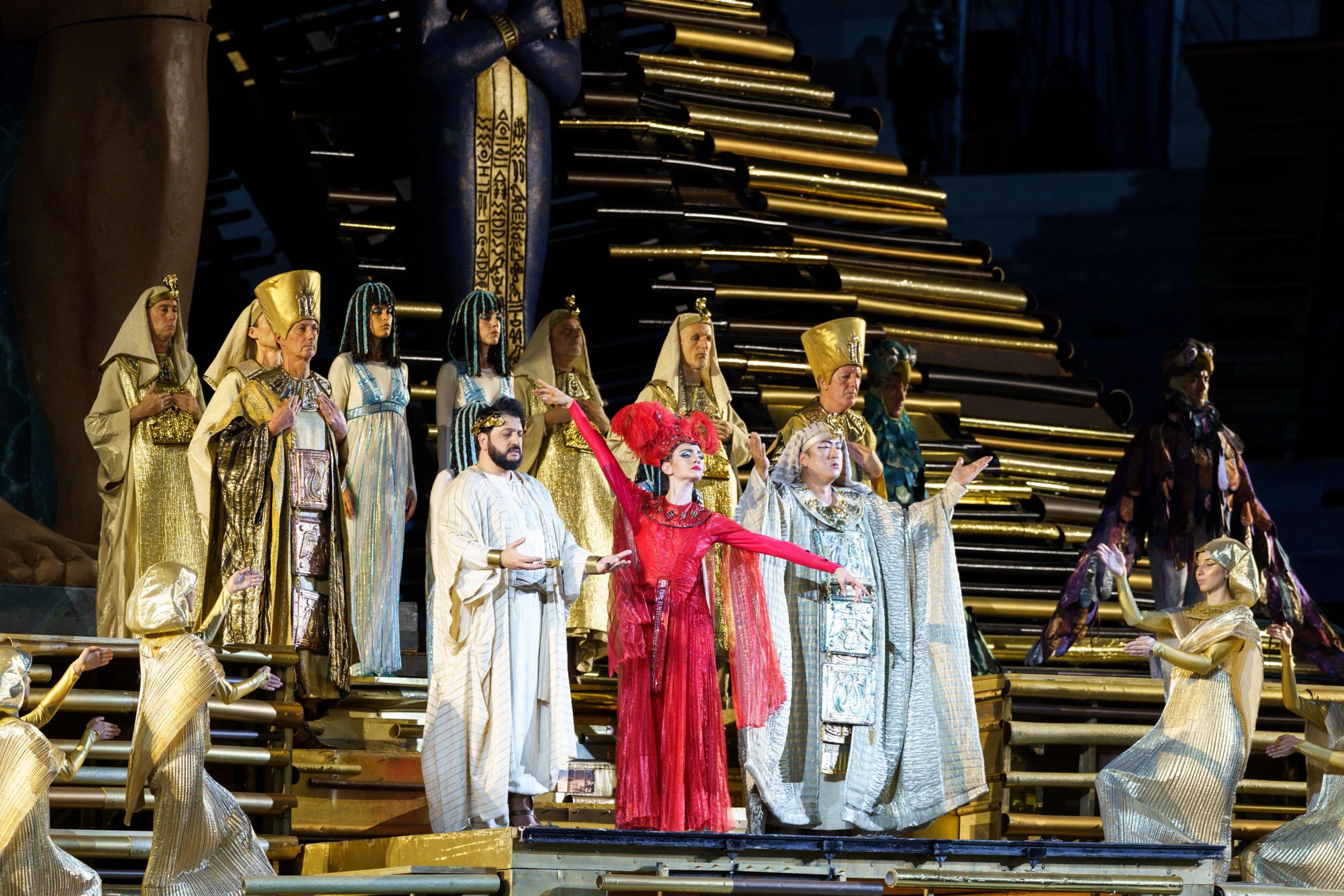
The production by Franco Zeffirelli continues to demonstrate its extraordinary ability to engage in dialogue with the architecture of the Arena. Whereas on other occasions his approach could be perceived as an exuberant celebration of spectacle, on this occasion it is striking for a certain search for a different atmosphere. The sets retain Zeffirelli’s characteristic magnificence, but also play with an interesting austerity that allows the costumes to take on a particularly prominent role.
The great pyramids, seen in their full dimensions, provide some of the production’s most visually striking moments. Particularly beautiful is Amneris’s chamber in the second act, where the space takes on a more intimate and elegant dimension. There is also a great deal of stage movement: entrances, exits, choral masses and movements perfectly integrated into a vibrant, brilliant and highly dynamic spectacle.
The costumes by Anna Anni work through contrast with the sets. In the face of the architectural monumentality of the stage, the costumes introduce a different kind of visual richness, creating a clear separation between the characters and the gigantic space surrounding them. The result is highly effective theatrically.
Leading the Orchestra, Chorus, Ballet and Technical Teams of the Fondazione Arena di Verona is Francesco Ommassini, a conductor who knows the ensemble well and offers a correct and experienced reading of the score. His prior knowledge of the orchestra is apparent in the confidence with which he leads the ensemble and in the fluency of the musical discourse.
The Arena Chorus, prepared by Roberto Gabbiani, gives a particularly noteworthy performance. The women’s chorus displays exceptional quality and contributes decisively to the atmosphere of some of the work’s most delicate moments. On the staging side, the work of Michele Olcese is particularly relevant. The staging is spectacular and succeeds in making use of the Arena’s extraordinary dimensions without completely losing its theatrical perspective.
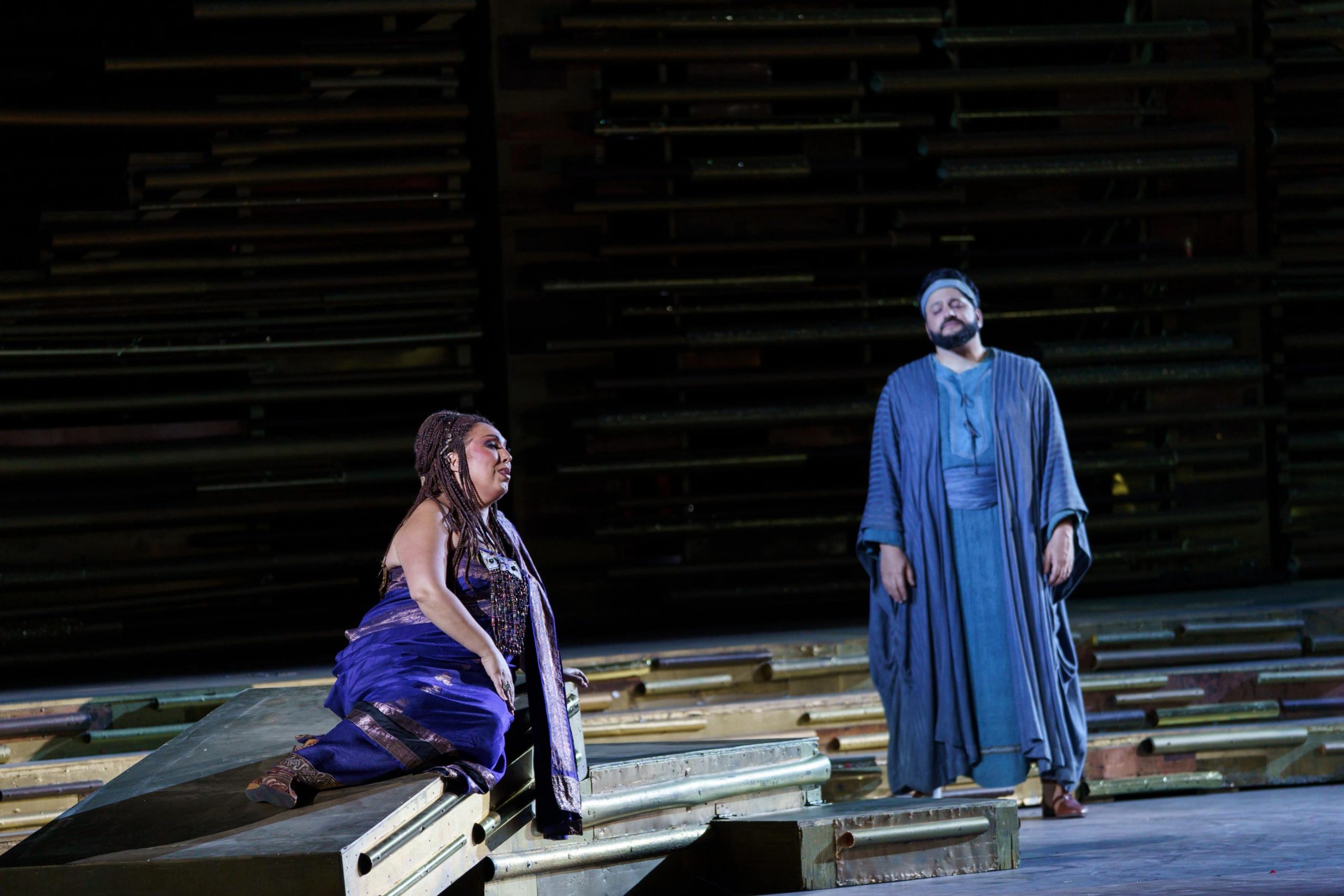
At the centre of the performance is Maria José Siri, an Aida with a beautiful voice, polished technique and remarkable expressive ability. Her instrument finds particularly favourable ground in Verdi, combining beauty of tone with a vocal line shaped with sensitivity.
One of the most interesting moments comes already in the first act, in the trio “Vieni, o diletta, appressati,” where Siri achieves very good rapport with Amneris and Radamès. The interaction between the three characters works naturally and allows the dramatic conflict to begin taking shape through the musical dialogue itself. Siri also offers an expressive Aida, capable of conveying the character’s fragility without turning her into a passive figure.
Yusif Eyvazov takes on the role of Radamès under a particularly striking circumstance: the previous day he had performed Calaf in Turandot. The vocal demands of both roles make his stamina and ability to recover particularly remarkable. His “Celeste Aida” was very well handled, with a secure vocal line and an appropriately heroic presence. But it is in the final duet with Aida, “O terra, addio,” that he reaches one of the most moving moments of the performance. The stage chemistry between Eyvazov and Siri works especially well in this final section, when the spectacular nature of the Arena gives way to the intimacy of the two lovers and the music takes on a more restrained and moving dimension.
Irene Savignano, as Amneris, gives a solid performance, with an instrument of distinctive vocal colour. The rivalry between Amneris and Aida nevertheless finds some moments of strong dramatic tension. Youngjun Park, as Amonasro, fulfils his role effectively, bringing the character the necessary authority and a voice of great presence. In the role of Ramfis, Simon Lim gives a solid performance, with a well-focused voice and a presence appropriately suited to the solemnity of the priest.
Also fulfilling their roles effectively are Mario Buccino, as the King, with a rounded voice; Riccardo Rados, as the Messenger; and Francesca Maionchi, as the Priestess.
If there is one aspect that deserves particularly enthusiastic mention, it is the ballet. Principal dancers Giorgia Ricciardi, Virna Toppi and Nicola Del Freo were fantastic. Coordinated by Gaetano Petrosino, their participation adds an additional dimension to the spectacle and demonstrates the extent to which Aida can become an experience that transcends the strictly operatic. Their presence on stage brings elegance, energy and spectacle.
Italiano: Nel 1913, il tenore Giovanni Zenatello (1876-1949), che aveva già creato ruoli per Puccini, Giordano, Cilea e altri compositori e si trovava ancora agli inizi della sua carriera, ebbe l’intuizione di portare l’opera all’Arena di Verona, la sua città natale. Già nel XIX secolo vi erano state alcune rappresentazioni, seppure sporadiche e prive di continuità, all’interno di una storia millenaria che aveva visto susseguirsi nell’anfiteatro ogni genere di spettacolo. L’idea — e il rischio finanziario — fu condivisa con l’impresario Ottone Rovato, con il sostegno dei maestri Ferruccio Cusinati e Tullio Serafin e della ormai leggendaria prova acustica effettuata con una moneta, il cui suono risultava perfettamente udibile da diversi punti dell’Arena.
Era necessaria una grande rappresentazione per celebrare il centenario della nascita di Giuseppe Verdi, e la scelta cadde su Aida, che debuttò il 10 agosto 1913, con Serafin sul podio e Zenatello nel ruolo di Radamès. La risonanza mediatica e il grande successo favorirono una nuova stagione l’estate successiva, con un nuovo titolo, Carmen, e molte altre edizioni, anche se la continuità venne interrotta dalle due guerre mondiali.
Come cantante, Giovanni Zenatello fu attivo dal 1898 al 1933. Dopo aver iniziato come baritono, divenne uno dei tenori più richiesti della sua epoca, con un repertorio di oltre quaranta ruoli. Considerato un rivale di Caruso — con il quale, tuttavia, mantenne una sincera amicizia — fu molto amato in patria e ancora di più all’estero. Nel corso della sua vita scoprì nuovi talenti e aiutò giovani colleghi a muovere i primi passi, tra cui Miguel Fleta, Lily Pons e Nino Martini.
È bello ricordare che, proprio dopo le difficoltà della guerra, furono nuovamente Zenatello e Serafin a prendere le redini del Festival nel 1947, nella seconda edizione celebrata dopo la guerra, guardando con fiducia al futuro e puntando sulla allora sconosciuta Maria Callas.
Attraverso conferenze, dediche speciali, una mostra e una pubblicazione, la Fondazione Arena di Verona lo ricorda ancora una volta nel 2026 con ammirazione e gratitudine, a 150 anni dalla sua nascita.
AIDA
Aida nacque in un contesto di enorme ambizione culturale e politica. Il kedivè d’Egitto, Ismail Pascià, commissionò a Verdi una nuova opera per il Teatro dell’Opera del Cairo, nell’ambito del progetto di modernizzazione ed europeizzazione che stava trasformando la città. Il soggetto, ispirato a un’idea attribuita all’egittologo francese Auguste Mariette, ambientava l’azione nell’antico Egitto e offriva a Verdi la possibilità di combinare il grande spettacolo con un dramma di profonde dimensioni umane.
L’opera debuttò infine il 24 dicembre 1871 al Cairo, sotto la direzione di Giovanni Bottesini, dopo diversi ritardi provocati, tra le altre circostanze, dalla guerra franco-prussiana, che aveva impedito di trasportare in Egitto le scenografie e i costumi realizzati a Parigi. Verdi non assistette alla prima. Inoltre, non rimase completamente soddisfatto delle circostanze di quella prima rappresentazione, il cui pubblico era composto principalmente da dignitari, politici e critici invitati. Per questa ragione considerò la prima alla Scala di Milano, l’8 febbraio 1872, come la vera presentazione dell’opera al pubblico europeo.
Il debutto al Cairo fu, tuttavia, un grande successo. La produzione era stata concepita con una straordinaria ricchezza visiva, sotto la supervisione di Mariette, responsabile anche dei disegni delle scenografie, dei costumi e degli accessori. La spettacolarità dell’allestimento era perfettamente in sintonia con la concezione monumentale della partitura.
La successiva accoglienza critica fu più complessa. A Milano, il pubblico accolse Aida con enorme entusiasmo, ma alcuni critici espressero delle riserve nei confronti di una partitura che combinava la tradizione dell’opera italiana con elementi associati alla cosiddetta «scuola moderna», tra cui influenze di Meyerbeer, Gounod e Wagner. Si discuteva, in particolare, dell’equilibrio tra la tradizionale melodia italiana e una scrittura orchestrale più sofisticata, così come della crescente continuità drammatica della musica verdiana.
Questo aspetto è fondamentale per comprendere Aida. Verdi, lungi dal limitarsi a scrivere una spettacolare grand opéraambientata in Egitto, aveva raggiunto una fase di piena maturità artistica. Le grandi scene corali e cerimoniali convivono con una scrittura intima e psicologica sempre più raffinata. La Marcia trionfale rappresenta il potere e la dimensione pubblica dello Stato egiziano; «Celeste Aida», «Ritorna vincitor!» e «O patria mia», invece, rivelano il conflitto interiore di personaggi intrappolati tra amore, dovere, patria e potere.
Più di un secolo dopo, la scelta di Aida per inaugurare la tradizione operistica dell’Arena di Verona nel 1913 assume così una dimensione quasi inevitabile. L’architettura monumentale dell’anfiteatro prolunga visivamente ciò che Verdi aveva concepito musicalmente: un’opera capace di riunire folle, cerimonie e spettacolo senza rinunciare all’intimità di una tragedia umana. L’Arena ha trasformato questa dimensione monumentale in uno dei suoi tratti distintivi e, da allora, Aidaè rimasta profondamente legata alla storia dell’anfiteatro veronese.
CAST
La produzione di Franco Zeffirelli continua a dimostrare la sua straordinaria capacità di dialogare con l’architettura dell’Arena. Se in altre occasioni la sua proposta poteva essere percepita come una celebrazione esuberante dello spettacolo, questa volta sorprende per una certa ricerca di nuove atmosfere. La scenografia conserva la magnificenza caratteristica di Zeffirelli, ma gioca anche con un’interessante austerità che permette ai costumi di assumere un ruolo di particolare rilievo.
Le grandi piramidi, osservate nella loro interezza, offrono alcuni dei momenti visivamente più suggestivi della produzione. Particolarmente bella è la stanza di Amneris nel secondo atto, dove lo spazio assume una dimensione più intima ed elegante. Vi è inoltre molto movimento scenico: entrate, uscite, masse corali e spostamenti perfettamente integrati in uno spettacolo vibrante, brillante e di grande dinamismo.
I costumi di Anna Anni funzionano per contrasto con la scenografia. Di fronte alla monumentalità architettonica del palcoscenico, i costumi introducono una diversa ricchezza visiva, creando una netta separazione tra i personaggi e il gigantesco spazio che li circonda. Il risultato è di grande efficacia teatrale.
Alla guida dell’Orchestra, del Coro, del Balletto e dei Tecnici della Fondazione Arena di Verona troviamo Francesco Ommassini, un direttore che conosce bene l’ensemble e che offre una lettura corretta ed esperta della partitura. La sua precedente conoscenza dell’orchestra si percepisce nella sicurezza con cui conduce l’insieme e nella fluidità del discorso musicale.
Il Coro dell’Arena, preparato da Roberto Gabbiani, offre una prestazione particolarmente notevole. Il coro femminile mostra una qualità speciale e contribuisce in modo decisivo all’atmosfera di alcuni dei momenti più delicati dell’opera. Sul piano scenico, il lavoro di Michele Olcese risulta particolarmente rilevante. La scenografia è spettacolare e riesce a sfruttare le straordinarie dimensioni dell’Arena senza perdere completamente la prospettiva teatrale.
Al centro della rappresentazione troviamo Maria José Siri, un’Aida dalla voce splendida, dalla tecnica curata e dalla notevole capacità espressiva. Il suo strumento trova in Verdi un terreno particolarmente favorevole, combinando bellezza timbrica e una linea vocale lavorata con sensibilità.
Uno dei momenti più interessanti arriva già nel primo atto, nel terzetto «Vieni, o diletta, appressati», dove Siri raggiunge un’ottima sintonia con Amneris e Radamès. L’interazione tra i tre personaggi funziona con naturalezza e permette al conflitto drammatico di iniziare a costruirsi attraverso lo stesso dialogo musicale. Siri offre inoltre un’Aida espressiva, capace di trasmettere la fragilità del personaggio senza trasformarla in una figura passiva.
Yusif Eyvazov affronta il ruolo di Radamès in una circostanza particolarmente significativa: il giorno precedente aveva interpretato Calaf in Turandot. L’esigenza vocale di entrambi i ruoli rende particolarmente notevoli la sua resistenza e la capacità di recupero. La sua «Celeste Aida» è stata molto ben risolta, con una linea vocale sicura e un’adeguata presenza eroica. È però nel duetto finale con Aida, «O terra, addio», che raggiunge uno dei momenti più emozionanti della rappresentazione. La sintonia scenica tra Eyvazov e Siri funziona particolarmente bene in questo tratto finale, quando la spettacolarità dell’Arena lascia spazio all’intimità dei due amanti e la musica assume una dimensione più raccolta e commovente.
Irene Savignano, nel ruolo di Amneris, offre un’interpretazione corretta, con uno strumento dal colore vocale particolare. La rivalità tra Amneris e Aida trova, tuttavia, alcuni momenti di buona tensione drammatica. Youngjun Park, come Amonasro, svolge correttamente il suo compito, apportando al personaggio l’autorità necessaria e una voce di grande presenza. Nel ruolo di Ramfis, Simon Lim offre una prova solida, con una voce ben focalizzata e una presenza che si adatta adeguatamente alla solennità del sacerdote.
Svolgono correttamente i loro ruoli anche Mario Buccino, come il Re, con una voce rotonda; Riccardo Rados, come il Messaggero; e Francesca Maionchi, come la Sacerdotessa.
Se c’è un settore che merita una menzione particolarmente entusiastica è il balletto. I primi ballerini Giorgia Ricciardi, Virna Toppi e Nicola Del Freo sono stati fantastici. Coordinati da Gaetano Petrosino, la loro partecipazione apporta una dimensione ulteriore allo spettacolo e dimostra fino a che punto Aida possa diventare un’esperienza che trascende la dimensione strettamente operistica. La loro presenza in scena apporta eleganza, energia e spettacolarità.
Español: En 1913, el tenor Giovanni Zenatello (1876-1949), quien ya había creado papeles para Puccini, Giordano, Cilea y otros compositores, y se encontraba aún en los inicios de su carrera, tuvo la visión de llevar la ópera a la Arena de Verona, su ciudad natal. Ya se habían realizado representaciones en el siglo XIX, aunque de manera esporádica y sin continuidad, dentro de una historia milenaria que había visto desfilar todo tipo de espectáculos por el anfiteatro. La idea —y el riesgo financiero— fue compartida con el empresario Ottone Rovato, con el respaldo de los maestros Ferruccio Cusinati y Tullio Serafin y de la ahora legendaria prueba acústica realizada con una moneda, cuyo sonido resultaba perfectamente audible desde distintos puntos de la Arena.
Se necesitaba una gran representación para celebrar el centenario del nacimiento de Giuseppe Verdi, y la elección recayó en Aida, que se estrenó el 10 de agosto de 1913, con Serafin en el podio y Zenatello en el papel de Radamés. La repercusión mediática y el rotundo éxito propiciaron una nueva temporada al verano siguiente, con un nuevo título, Carmen, y muchas otras ediciones, aunque la continuidad se vio interrumpida por las dos guerras mundiales.
Como cantante, Giovanni Zenatello estuvo activo desde 1898 hasta 1933. Tras comenzar como barítono, se convirtió en uno de los tenores más solicitados de su época, con un repertorio de más de cuarenta papeles. Considerado rival de Caruso —con quien, sin embargo, mantuvo una sincera amistad—, fue muy querido en su país y aún más en el extranjero. A lo largo de su vida, descubrió talentos y ayudó a jóvenes colegas a dar sus primeros pasos, entre ellos Miguel Fleta, Lily Pons y Nino Martini.
Es hermoso recordar que, precisamente tras las dificultades de la guerra, fueron de nuevo Zenatello y Serafin quienes tomaron las riendas del Festival en 1947, en la segunda edición celebrada después de la guerra, mirando con confianza al futuro y apostando por la entonces desconocida Maria Callas.
A través de conferencias, dedicatorias especiales, una exposición y una publicación, la Fondazione Arena di Verona lo recuerda una vez más en 2026 con admiración y gratitud, 150 años después de su nacimiento.
AIDA
Aidanació en un contexto de enorme ambición cultural y política. El jedive de Egipto, Ismail Pachá, encargó a Verdi una nueva ópera para el Teatro de la Ópera de El Cairo, dentro del proyecto de modernización y europeización que estaba transformando la ciudad. El argumento, inspirado en una idea atribuida al egiptólogo francés Auguste Mariette, situaba la acción en el antiguo Egipto y ofrecía a Verdi la posibilidad de combinar el gran espectáculo con un drama de profundas dimensiones humanas.
La ópera se estrenó finalmente el 24 de diciembre de 1871 en El Cairo, bajo la dirección de Giovanni Bottesini, después de diversos retrasos provocados, entre otras circunstancias, por la guerra franco-prusiana, que había impedido trasladar a Egipto los decorados y vestuarios realizados en París. Verdi no asistió al estreno. Además, no quedó completamente satisfecho con las circunstancias de aquella primera representación, cuyo público estaba compuesto principalmente por dignatarios, políticos y críticos invitados. Por esta razón, consideró el estreno de La Scala de Milán, el 8 de febrero de 1872, como la verdadera presentación de la obra ante el público europeo.
El estreno cairota fue, sin embargo, un gran éxito. La producción había sido concebida con una extraordinaria riqueza visual, bajo la supervisión de Mariette, responsable también de los diseños de los decorados, vestuario y accesorios. La espectacularidad de la puesta en escena estaba en perfecta consonancia con la concepción monumental de la partitura.
La recepción crítica posterior fue algo más compleja. En Milán, el público acogió Aida con enorme entusiasmo, pero algunos críticos mostraron reservas ante una partitura que combinaba la tradición de la ópera italiana con elementos asociados a la llamada «escuela moderna», entre ellos influencias de Meyerbeer, Gounod y Wagner. Se discutía, en particular, el equilibrio entre la melodía italiana tradicional y una escritura orquestal más sofisticada, así como la creciente continuidad dramática de la música verdiana.
Esta cuestión resulta fundamental para comprender Aida. Verdi, lejos de limitarse a escribir una espectacular grand opéra ambientada en Egipto, había alcanzado una etapa de plena madurez artística. Las grandes escenas corales y ceremoniales conviven con una escritura íntima y psicológica cada vez más refinada. La Marcha triunfal representa el poder y la dimensión pública del Estado egipcio; «Celeste Aida», «Ritorna vincitor!» y «O patria mia», en cambio, revelan el conflicto interior de personajes atrapados entre el amor, el deber, la patria y el poder.
Más de un siglo después, la elección de Aida para inaugurar la tradición operística de la Arena di Verona en 1913 adquiere así una dimensión casi inevitable. La arquitectura monumental del anfiteatro prolonga visualmente aquello que Verdi había concebido musicalmente: una ópera capaz de reunir multitudes, ceremonias y espectáculo sin renunciar a la intimidad de una tragedia humana. La Arena convirtió esa dimensión monumental en una de sus señas de identidad y, desde entonces, Aida ha quedado profundamente vinculada a la historia del anfiteatro veronés.
CAST
La producción de Franco Zeffirelli continúa demostrando su extraordinaria capacidad para dialogar con la arquitectura de la Arena. Si en otras ocasiones su propuesta podía percibirse como una celebración exuberante del espectáculo, en esta ocasión sorprende por una cierta búsqueda de otros aires. La escenografía conserva la magnificencia característica de Zeffirelli, pero juega también con una interesante austeridad que permite que el vestuario adquiera un protagonismo especial.
Las grandes pirámides, contempladas en toda su dimensión, ofrecen algunos de los momentos visualmente más impactantes de la producción. Especialmente hermosa resulta la habitación de Amneris en el segundo acto, donde el espacio adquiere una dimensión más íntima y elegante. Hay, además, mucho movimiento escénico: entradas, salidas, masas corales y desplazamientos perfectamente integrados en un espectáculo vibrante, brillante y de gran dinamismo.
Los vestuarios de Anna Anni funcionan por contraste con la escenografía. Frente a la monumentalidad arquitectónica del escenario, el vestuario introduce una riqueza visual diferente, creando una separación clara entre los personajes y el gigantesco espacio que los rodea. El resultado es de gran eficacia teatral.
Al frente de la Orquesta, Coro, Ballet y Técnicos de la Fondazione Arena di Verona se encuentra Francesco Ommassini, un director que conoce bien la formación y que ofrece una lectura correcta y experimentada de la partitura. Su conocimiento previo de la orquesta se percibe en la seguridad con la que conduce el conjunto y en la fluidez del discurso musical.
El Coro de la Arena, preparado por Roberto Gabbiani, ofrece un rendimiento particularmente destacable. El coro femenino muestra una especial calidad y contribuye de manera decisiva a la atmósfera de algunos de los momentos más delicados de la obra. En el apartado escénico, el trabajo de Michele Olcese resulta especialmente relevante. La escenografía es espectacular y consigue aprovechar las dimensiones extraordinarias de la Arena sin perder por completo la perspectiva teatral.
En el centro de la representación se encuentra Maria José Siri, una Aida de voz preciosa, técnica cuidada y notable capacidad expresiva. Su instrumento encuentra en Verdi un terreno especialmente favorable, combinando belleza tímbrica con una línea vocal trabajada con sensibilidad.
Uno de los momentos más interesantes llega ya en el primer acto, en el terceto «Vieni, o diletta, appressati», donde Siri consigue una muy buena compenetración con Amneris y Radamès. La interacción entre los tres personajes funciona con naturalidad y permite que el conflicto dramático comience a construirse desde el propio diálogo musical. Siri ofrece, además, una Aida expresiva, capaz de transmitir la fragilidad del personaje sin convertirla en una figura pasiva.
Yusif Eyvazov afronta el papel de Radamès con una circunstancia especialmente llamativa: el día anterior había interpretado a Calaf en Turandot. La exigencia vocal de ambos papeles hace especialmente notable su resistencia y capacidad de recuperación. Su «Celeste Aida» estuvo muy bien resuelta, con una línea vocal segura y una adecuada presencia heroica. Pero es en el dúo final con Aida, «O terra, addio», donde alcanza uno de los momentos más emotivos de la representación. La química escénica entre Eyvazov y Siri funciona especialmente bien en este tramo final, cuando la espectacularidad de la Arena deja paso a la intimidad de los dos amantes y la música adquiere una dimensión más recogida y conmovedora.
Irene Savignano, como Amneris, ofrece una interpretación correcta, con un instrumento de un color vocal particular. La rivalidad entre Amneris y Aida encuentra, no obstante, buenos momentos de tensión dramática. Youngjun Park, como Amonasro, cumple correctamente con su cometido, aportando la autoridad necesaria al personaje y una voz de gran presencia. En el papel de Ramfis, Simon Lim ofrece una actuación sólida, con una voz bien focalizada y una presencia que se adapta adecuadamente a la solemnidad del sacerdote.
También cumplen correctamente sus cometidos Mario Buccino, como el Rey, con una voz redonda; Riccardo Rados, como el Mensajero; y Francesca Maionchi, como la Sacerdotisa.
Si hay un apartado que merece una mención especialmente entusiasta es el ballet. Los primeros bailarines Giorgia Ricciardi, Virna Toppi y Nicola Del Freo estuvieron fantásticos. Coordinados por Gaetano Petrosino, su participación aporta una dimensión adicional al espectáculo y demuestra hasta qué punto Aida puede convertirse en una experiencia que trasciende lo estrictamente operístico. Su presencia sobre el escenario aporta elegancia, energía y espectacularidad.
Photo credits: Ennevi Foto | Fondazione Arena di Verona