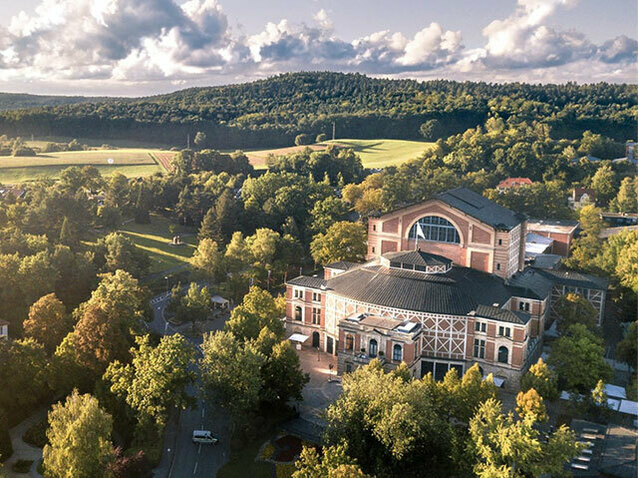

On a quiet hill in northern Bavaria, in the modest town of Bayreuth, stands a building that does not immediately overwhelm with grandeur. Its exterior is almost austere – brick, restrained, nearly anonymous. And yet, for those who make the pilgrimage each summer, it is nothing less than a temple. This is the Bayreuther Festspielhaus—the Palais des Festivals of Bayreuth—a place where music, myth, and obsession have intertwined for nearly a century and a half.
A Vision Born of Restlessness
The story begins not with architecture, but with dissatisfaction. In the mid-19th century, composer Ricard Wagner had grown frustrated with the opera houses of this time. They were too ornate, too political, too constrained by convention. Wagner did not simply want to compose operas – he wanted to reinvent the very experience of them. Around 1850, he began imagining a “festival” dedicated entirely to his works, a place where audiences would gather not for social display, but for immersion in music drama. It would take more than two decades for that dream to find a home. After considering cities like Munich and Zurich, Wagner turned his attention to Bayreuth—a quiet Franconian town whose existing opera house proved unsuitable, but whose atmosphere captivated him. Bayreuth, in its simplicity, offered something radical: freedom.
Building a Temple for Sound
Construction of the Festspielhaus began in 1872, on what would later be called the “Green Hill.” The design was revolutionary. Wagner adapted ideas from architect Gottfried Semper but reshaped them according to his own radical vision. Inside, everything served the music. The orchestra pit was hidden beneath the stage—covered, recessed, almost invisible. This unusual feature blended the sound, creating an acoustic experience unlike any other opera house before or since. The auditorium itself was fan-shaped, ensuring that every spectator faced the stage directly, eliminating the social hierarchies of boxes and balconies. Even the lights were dimmed—a novelty at the time—forcing audiences to focus entirely on the drama unfolding before them. This was not just architecture. It was ideology made concrete.
1876: A Beginning That Changed Opera
On August 13, 1876, the Festspielhaus opened with the premiere of Wagner’s monumental cycle, Der Ring des Nibelungen. Over four operas and many hours, audiences experienced something unprecedented: a total artwork, or Gesamtkunstwerk, where music, poetry, staging, and philosophy fused into a single overwhelming experience. The Bayreuth Festival was born.
From the beginning, it was exclusive, even elusive. Tickets were scarce. The audience included kings, composers, and intellectuals from across Europe. Attending Bayreuth was not merely cultural—it was almost spiritual. And unlike other festivals, this one had a strict rule: only Wagner’s works would be performed here.
A Family Legacy—and a Complicated One
After Wagner’s death in 1883, the festival became a family affair. His widow Cosima took over, followed by their descendants, who would shape Bayreuth’s identity for generations. But the festival’s history is not without shadows. During the 20th century, Bayreuth became entangled with German nationalism and, most controversially, with the Nazi regime. Adolf Hitler was a frequent guest, and the festival was used, at times, as a cultural symbol of ideological power.
After World War II, Bayreuth faced an uncertain future. Much of the town had been destroyed, though the Festspielhaus itself survived. The festival paused, then cautiously re-emerged in 1951 with a symbolic performance of Beethoven’s Ninth Symphony. It was a moment of rebirth—but also reinvention.
“New Bayreuth”: Breaking with Tradition
The postwar era brought a dramatic shift. Under Wagner’s grandsons, Wieland and Wolfgang, the festival entered what became known as “New Bayreuth.” Gone were the elaborate sets and historical realism. In their place came minimalism—abstract staging, stark lighting, and psychological depth. The goal was to strip away nationalism and spectacle, revealing the universal human themes in Wagner’s work. Audiences were shocked. Some booed. Others were captivated. Over time, these bold reinterpretations came to define modern opera direction, influencing stages far beyond Bayreuth.
The Festival Today: Between Reverence and Reinvention
Today, the Bayreuth Festival remains one of the most prestigious—and debated—events in classical music. Every summer, audiences from around the world gather on the Green Hill, often after waiting years for tickets. The Festspielhaus itself remains largely unchanged. Its acoustics, still considered among the finest in the world, continue to shape performances in subtle, almost mystical ways. And yet, the productions inside are anything but static.
Modern directors bring contemporary interpretations—sometimes controversial, often daring. Traditionalists and innovators clash, just as they did decades ago. This tension is part of what keeps Bayreuth alive. Even today, the festival evolves. Its 150th anniversary celebrations, for example, reflect both its enduring legacy and the practical challenges of sustaining such a unique institution in the modern world.
The Surrounding City: A Quiet Stage
While the Festspielhaus sits on its hill, the heart of Bayreuth—particularly the elegant Opernstraße—offers a different kind of cultural atmosphere. Lined with historic façades and shaped by centuries of artistic patronage, the district reflects a quieter, everyday relationship with music and performance. Here, the festival’s presence lingers not in spectacle, but in rhythm: cafés filled with post-performance discussions, streets alive with anticipation during the summer season.
A Living Paradox
What makes the Bayreuth Festival so enduring is its paradoxical nature. It is both rigid and experimental. Exclusive yet influential. Rooted in the 19th century, yet constantly redefining itself. The Festspielhaus, built for a single composer’s vision, has become a global symbol of artistic ambition. And every summer, as the first notes rise from the hidden orchestra pit, that original vision feels astonishingly alive.
In Bayreuth, history is not something preserved behind glass.
It is performed—again and again.