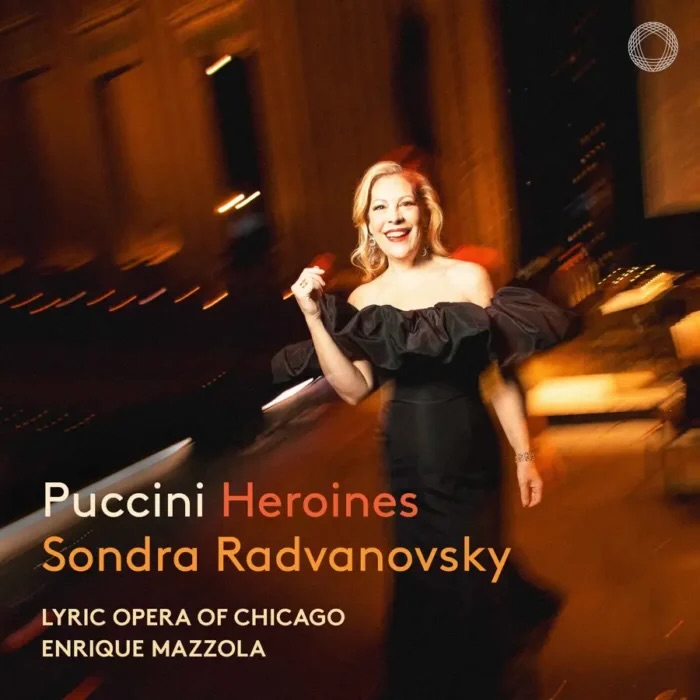
Sondra Radvanovsky’s Puccini Heroines: A Triumphant Celebration of Passion, Power, and Emotion 

Author:

by Carla Coppola

INTERVIEW

Soprano Sondra Radvanovsky has long been celebrated for her dramatic intensity and vocal prowess, but in her latest recording,Puccini Heroines, she takes us on a journey through the heart of Puccini’s operatic world with an intimacy and depth that few can match. This album is not merely a showcase of technique; it is a testament to Radvanovsky’s ability to embody character and bring the emotional landscape of Puccini’s women to vivid life. 

From the opening notes, it is evident that Radvanovsky approaches each aria with both respect for the composer’s genius and her own interpretive insight. Her Mimi (La Bohème) is tender, vulnerable, and achingly human. There is a delicate fragility in her voice that captures Mimi’s innocence and longing, yet Radvanovsky never sacrifices tonal richness or clarity. Each line she sings seems to tell a story, whether it’s a whisper of hope or a lamentation of loss, drawing the listener into Mimi’s world with profound intimacy. 

Contrast this with her portrayal of Turandot, in which Radvanovsky commands the stage with an almost imperious authority. Here, she balances icy regal power with subtle hints of emotion, revealing the inner complexity of Puccini’s famously formidable princess. Her articulation is precise, her dramatic instincts impeccable, and her voice cuts through the orchestration with thrilling clarity. One cannot help but be captivated by the tension she creates between the character’s fearsome exterior and her hidden vulnerability. 

Radvanovsky’s Manon LescautandTosca are similarly compelling. She navigates Manon’s youthful exuberance and tragic fate with a keen sense of dramatic timing, infusing each phrase with emotional truth. InTosca, she channels the character’s fierce determination and passionate love with a voice that is both commanding and sensually expressive. It is in these moments that Radvanovsky’s artistry transcends mere technique; she becomes the character, offering a fully realized dramatic experience that lingers long after the final note. 

The orchestral accompaniment throughout the album is sensitive and responsive, providing a lush backdrop that enhances Radvanovsky’s performance without ever overwhelming it. The subtle interplay between voice and orchestra in the slower, more lyrical arias allows for moments of quiet introspection, while the dramatic climaxes are rendered with thrilling intensity, highlighting the full range of both Puccini’s compositions and Radvanovsky’s vocal capabilities. 

What makes this recording particularly remarkable is Radvanovsky’s ability to maintain both power and nuance simultaneously. She navigates the demanding tessitura of Puccini’s heroines with technical mastery, yet never allows vocal fireworks to overshadow emotional authenticity. Every crescendo, every pianissimo, every carefully shaped phrase serves the drama and brings the characters’ inner lives into sharp relief. 

Puccini Heroines is ultimately a celebration of both the composer’s genius and the interpretive skill of one of opera’s leading sopranos. It offers listeners an opportunity to experience Puccini’s iconic female characters through the lens of an artist who understands not only the technical demands of the repertoire but also the profound emotional resonance that makes these roles timeless. Radvanovsky’s performance is a masterclass in operatic storytelling: bold, heartfelt, and unforgettable. It is Mazzola’s conducting that frames these performances, shaping the orchestral sound in ways that allow the soprano’s voice to soar without ever losing the richness of Puccini’s score. His approach is attentive, responsive, and dramatically intelligent: he seems to intuitively understand when to push the orchestra forward and when to pull back, creating an environment in which Radvanovsky can inhabit her characters fully. 

Mazzola brings a rare combination of precision and emotional insight to the music. In the lyrical passages of Manon Lescaut, for example, he supports Radvanovsky’s expressive phrasing with a delicate orchestral palette, emphasizing subtle shifts in mood and tension. In the dramatic climaxes of Tosca or Turandot, he allows the orchestra to swell with grandeur while maintaining clarity and focus, ensuring that Radvanovsky’s voice never gets lost in the intensity. The result is a seamless partnership between singer and conductor, where the music breathes naturally and every emotional nuance is conveyed with impact. 

For anyone seeking a recording that combines vocal brilliance with dramatic insight, Puccini Heroines is an essential addition to the collection. It is a vivid reminder of why Sondra Radvanovsky continues to captivate audiences worldwide and why Puccini’s women remain some of the most compelling figures in the operatic canon. This is not just an album—it is an intimate, thrilling journey through the passions, heartbreaks, and triumphs of some of opera’s most extraordinary heroine.

RELATED POSTS

Part II: You cannot starve yourself and expect yourself to sing well
So, what was the turning point for me? I stumbled across this concept called intuitive eating and after following a few certified dietitians on Instagram (such as Colleen Christensen and Bonnie Roney) trying to implement the intuitive eating principles, I knew that I had to dig deeper and find the founder of this concept and...
March 2025
Daria Rybak
Grand Théâtre de Genève: A Masterpiece of Architecture and Elegance
The Grand Théâtre de Genève is one of Switzerland’s most prestigious cultural landmarks, renowned for its rich history and contribution to the world of opera, ballet, and classical music. This historic venue is the beating heart of the city’s opera scene, and whether you’re a seasoned art lover or just curious about the cultural vibe,...
March 2025
Alice Lechner

Alice Lechner

Alice Lechner comes from a music-loving family. Her first encounter with the opera universe was at the tender age of six. The grandeur of the stage productions and costumes, the backstage chatter, and last, but definitely not least, the music left her in awe, beginning with Mozart’s Don Giovanni. The overall feeling that opera awakens in anyone who gets a glimpse into this part of artistic eternity, that each and every day passes the test of time, was what drew her to stay and be a part of this world. The Opera House of Brașov became her second home, and the people who worked there were her second family.

Since then, Alice has devoted her spare time to maximising her musical knowledge through instrumental studies, studying both piano and violin for a short time. In the following years, her number one passion stepped out of the limelight and graciously gave way to Law Studies.
Since 2018 she has been studying Law at “Alexandru Ioan Cuza” University in Iași.

Her passion for opera, even if it is no longer her top professional priority in terms of career, it has most definitely become her priority during her free time. Wanting to experience the best of both worlds and extend her musical horizons, she regularly attends opera performances throughout Romania and abroad.
With OPERA Charm Magazine, Alice aims to nurture her creative side to help it flourish and bloom and to discover, alongside the magazine’s readers, the fascinatingly complex world of opera.

Currently, she is an LL.M. in Business Law at “Alexandru Ioan Cuza” University in Iași.

Oana Zamfir

Oana Zamfir is a second year MA student at the “George Enescu” National University of Arts, at the Department of Musicology.

She studied violin for 12 years at the “Stefan Luchian” High School of Art in Botosani, later focusing on the theoretical aspects of music. In 2019 she completed her bachelor studies in Musicology as a student of the National Academy of Music “Gheorghe Dima” in Cluj-Napoca. Her research during 2018-2019 brought to the forefront elements of the archaic ritual within works of composers who activated during the communist period, giving her the opportunity to start a research internship at the “Carl von Ossietzky” University in Germany. In this context, she recorded conversations with members of the Sophie Drinker Institute in Bremen, and had access to documents directly from the Myriam Marbé archive.

Since 2019 she has been a teacher of Music Education and Theoretical Music Studies, making full use of interactive methods in the musical training of students and working, at the same time, with the children’s choir founded in the first year of her activity.

Her interests include pursuing a degree in interior design in 2020.

Alexandru Suciu

Alexandru Suciu inherited his passion for art growing up in a family of several generations of musicians. He began his musical studies at the “Augustin Bena” School of Music in Cluj, where he studied piano and guitar. Even though his main study direction was philological, his passion for music prevailed. He began his academical journey at the Faculty of Letters of the “Babeș-Bolyai” University, studying Comparative literature and English. He continued by studying Opera Singing at the “Gheorghe Dima” National Music Academy. He also graduated the Musical Education section, followed by Artistic Directing at the Musical Performing Arts department.

His multidisciplinary education opened the doors towards research, which is seen both through his participation in national and international conferences and symposia, such as the Salzburg Easter School PhD-forum, organized by the Salzburg Universität or the Silesian Meeting of Young Scholars, organized by the Institute of English at the University of Silesia, as well as the collaboration with Opera Charm Magazine.

During his student years, he won several prizes, including the Grand Prize at the “Paul Constantinescu” National Musical Interpretation Competition, the Romanian Composers and Musicologists’ Union Prize at the same competition, the First Prize and the Schubert Prize at the “Ada Ulubeanu” Competition.

He further developed his artistic skills by specializing in courses and masterclasses held by personalities such as Vittorio Terranova, Giuseppe Sabbatini, Marian Pop, Ines Salazar, Riccardo Zanellato, Paolo Bosisio, Valentina Farcaș and Manuel Lange in contexts such as the Internationale Sommerakademie für Operngesang Deutschlandsberg, Corso Internazionale di Canto Lirico I.M.C. Licata or the Europäische Akademie für Musik und darstellende Kunst Montepulciano. Besides his activity on-stage, he currently teaches Opera Singing Didactics, and Pedagogical Practice within the Department for Teacher Education and Training at the “Gheorghe Dima” National Music Academy.

Cristina Fieraru

Cristina is a 24 year-old Romanian soprano & a student at the National University of Music Bucharest, where she pursues the MA program in Vocal Performance.

She made her debut in Pamina from “Die Zauberflöte” by Wolfgang Amadeus Mozart at only 19 years old at the Bucharest National Opera House, as a member of the Ludovic Spiess Experimental Opera Studio. Over the years she made her debut in roles such as Contessa d’Almaviva (Le nozze di Figaro), Mimì & Musetta (La Bohème), Alice Ford (Falstaff), Erste Dame (Die Zauberflöte) in her university’s opera productions.
Her passion and experience extends in the field of choral music, too.

She has been part of our dream team since the fall of 2021. For a good period of time she took care of OPERA Charm’s social media and took you on the monthly journey through the history of opera through our Legends rubric – and a few times through the Theaters around the World rubric.

Her little soul rubric – from 2021 to present – is definitely the Conductors of the Future, where, every month, she gives you the chance to meet a young star of the world of conducting and, of course, to find out what’s the most charming feature of opera in these artists’ views.

BIANCA L. NICA

Lorem ipsum dolor sit amet, consetetur sadipscing elitr, sed diam nonumy eirmod tempor invidunt ut labore et dolore magna aliquyam erat, sed diam voluptua. At vero eos et accusam et justo duo dolores et ea rebum. Stet clita kasd gubergren, no sea takimata sanctus est Lorem ipsum dolor sit amet. Lorem ipsum dolor sit amet, consetetur